Dispatch
Reviewed October 2026 by Sergey Syrvachev
Dispatch is the act of deciding when a grid-scale battery charges, discharges, or holds idle, and at what power — translating a market signal, an operator schedule, or an automatic grid-service trigger into real-time setpoints sent to the power conversion system (PCS).
It is the layer of control that sits between commercial intent (revenue, contract obligations) and physical execution: real power in MW and reactive power in MVAr, measured at the point of interconnection (POI). Every megawatt-hour a BESS earns, and every grid service it delivers, flows through a dispatch decision.
New to BESS? Start free in the Learn BESS hub — no cost, no account.
What dispatch actually is
In a stationary BESS, dispatch is the continuous selection of an operating point — a commanded real power (P, in MW) and often reactive power (Q, in MVAr) — that the site's energy management system or power plant controller issues to the PCS.
The command can be positive (discharge to the grid) or negative (charge from the grid), bounded by state of charge (SOC), thermal limits, and the inverter's P-Q capability curve. Below this layer sits the battery management system, which dispatches nothing itself but publishes the charge and discharge power limits every command must respect; above it sits the market, the offtaker, or the grid operator.
Dispatch arrives from three broad sources. Economic dispatch follows a market price or an optimizer's schedule — for example, charging through low-price midday solar and discharging into the evening peak, or following an ISO/RTO's 5-minute economic basepoint. Scheduled dispatch follows a fixed contractual profile agreed with an offtaker or utility. Automatic dispatch responds to grid conditions in real time — frequency response, automatic generation control (AGC), or voltage and reactive support — without a human or market round-trip in the loop.
Whatever the source, a dispatch decision ultimately resolves into a setpoint: a numeric target with a defined reference point and tolerance, pushed down the command path from the utility or market interface through SCADA and the plant controller to individual PCS units, typically within about 1 to 5 seconds end to end. A useful mental split: dispatch is the decision — what power, when, and why — while setpoint tracking is the execution, how faithfully the plant follows the command. Market rules and contracts grade both, separately.
 Interactive · bess.engineer ↗
 Numbers
Key facts
| Commanded quantities | Real power P (MW), often reactive power Q (MVAr), bounded by SOC, thermal limits, and PCS P-Q curve |
|---|---|
| Real-time market interval | 5-minute economic dispatch (e.g. ERCOT SCED, CAISO RTD) |
| AGC / regulation signal rate | ~2-6 s update cycle, performance-scored in most markets |
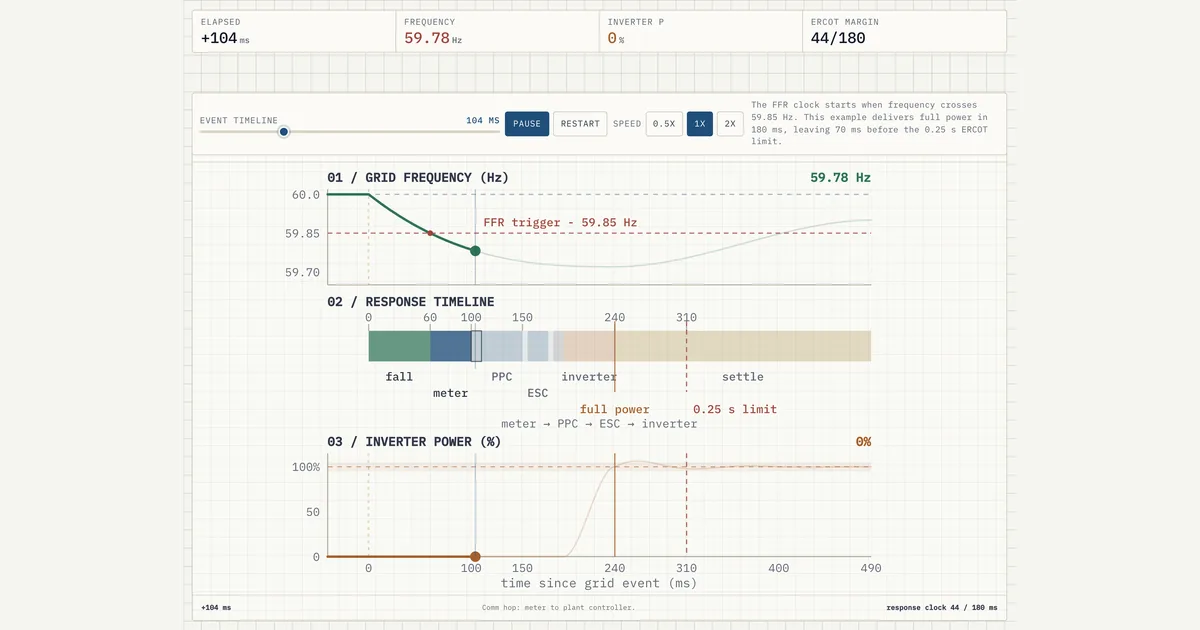
| Fast frequency response | ERCOT FFR: full output within ~0.25 s (15 cycles), sustained ≥15 min |
| Command-path latency | ~1-5 s from market/utility interface through SCADA and plant controller to PCS |
| Setpoint tracking tolerance | Commonly within 1-2% of commanded value at steady state |
| Ramp capability vs limits | PCS can slew 0-100% in <1 s; grid operators often cap at ~10%/min where smoothing is required |
| Typical energy-duty C-rate (LFP, 2-4 h) | ~0.25C to 0.5C; higher for short-duration ancillary services |
| Warranty cycling budget | Typically ~1 full cycle/day, 300-400 equivalent cycles/year, plus MWh throughput caps |
| Arbitrage break-even | Discharge/charge price ratio ≳1.1-1.2 at 85-90% AC round-trip efficiency, before degradation cost |
| Interconnection / interoperability | IEEE 1547 (distribution) or IEEE 2800 (bulk IBR); DNP3, IEC 60870-5-104, IEC 61850, Modbus, IEEE 2030.5 comms |
| Dispatch ceiling | Lesser of POI interconnection limit and PCS MVA rating, within grid-code ramp/droop rules |
Typical values and standards
Telemetry and response speed are the headline figures. Market setpoints for energy typically update on 5-minute economic intervals (SCED in ERCOT, RTD in CAISO), while AGC regulation signals update roughly every 2 to 6 seconds.
Autonomous frequency response acts faster still: primary frequency response through droop begins within seconds, and ERCOT's fast frequency response product requires full output within about 0.25 seconds (15 cycles) of the frequency trigger, sustained for at least 15 minutes. Utility-scale LFP systems commonly run at 0.25C to 0.5C for 2-4 hour energy duty, with higher C-rates specified for short-duration ancillary services.
On the standards side, dispatch behavior intersects the interconnection requirements that apply to the project: IEEE 1547 for distribution-connected resources, including ride-through and grid-support functions, and IEEE 2800 for bulk-system inverter-based resources at transmission level.
Communications between EMS, plant controller, PCS, and utility SCADA typically run over DNP3, IEC 60870-5-104, IEC 61850, Modbus, or IEEE 2030.5, and the regional grid code sets droop, deadband, and reactive requirements. Dispatch is a controls-and-software concern, distinct from the safety standards governing the asset itself — UL 9540 (system safety certification), UL 9540A (fire-propagation test method), and NFPA 855 (installation) constrain how the battery is built and sited, not how it is dispatched.
Two more numbers anchor economic dispatch. A modern PCS can slew from zero to full power in well under a second, but interconnection agreements often impose ramp-rate limits, commonly in the range of 10% of nameplate per minute where the grid operator requires smoothing. And AC round-trip efficiency of roughly 85-90% means energy arbitrage only pays when the discharge-to-charge price ratio clears about 1.1 to 1.2 before counting degradation cost — a threshold the dispatch optimizer must price into every cycle it commits.
In practice
Why it matters on a real project
Dispatch is where the business case is won or lost. The same hardware can earn very different revenue depending on whether it is dispatched for energy arbitrage, capacity, or fast ancillary services, and how well the EMS respects round-trip efficiency, augmentation budgets, and warranty cycle limits.
Over-aggressive dispatch — deep daily cycling, sustained high C-rates — accelerates calendar and cycle degradation and can breach throughput warranties; overly conservative dispatch leaves revenue and grid-service payments on the table. Stacking multiple services against one SOC budget is the core optimization problem.
Dispatch also has hard physical and compliance consequences. Commands must stay inside the POI interconnection limit, the PCS apparent-power (MVA) rating, and grid-code requirements for ramp rate, frequency droop, and reactive capability. A dispatch instruction that ignores SOC headroom or auxiliary loads (HVAC, controls) will under-deliver at the meter, and persistent under-delivery against an AGC or frequency-response signal triggers penalties or performance-score reductions in most organized markets. Availability and response accuracy are measured continuously, not audited once a year.
How it shows up in specs, studies and contracts
In commercial documents, dispatch rights define who controls the asset. A tolling agreement gives the offtaker dispatch rights while the owner guarantees availability, typically 95-98% measured monthly or annually, with liquidated damages below the floor.
The same contract caps how hard the offtaker may run the plant: cycles per day and per year, annual MWh throughput, SOC operating window, and sometimes resting-SOC rules. Battery supply warranties mirror this with degradation tables keyed to an assumed dispatch profile — usually around one full cycle per day, 300-400 equivalent cycles per year — so the operating and warranty documents must describe the same duty.
On the technical side, expect dispatch to appear in the interconnection agreement (AGC interface, ramp limits, voltage schedule), the plant controller functional specification, and commissioning test reports that demonstrate setpoint tracking.
Questions a working engineer should ask: what is the signal update rate and the required response time; what tracking tolerance applies, commonly within 1-2% of the commanded value at steady state; is the setpoint referenced at the POI or at PCS terminals; how are auxiliary loads treated in the delivered-energy measurement; and what SOC and temperature conditions void the response-time guarantee.
Pitfalls
Common pitfalls
The most common trap is reference-point confusion. A 100 MW dispatch command referenced at PCS terminals delivers less at the POI after transformer and collection losses and auxiliary consumption, so a plant that tracks its inverter setpoints perfectly can still fail a POI-metered performance test.
The second trap is SOC arithmetic: usable energy shrinks with the SOC window, temperature-derated power limits from the battery management system, and state-of-health decline, so a dispatch plan built on nameplate MWh will over-commit within a few years unless the optimizer tracks actual usable capacity.
Finally, watch the warranty-versus-market conflict. A price optimizer left unconstrained will happily run two cycles a day in a volatile market, doubling the cycle budget the degradation guarantee assumed. Cycle-counting definitions also differ — some warranties count equivalent full cycles from total throughput, others count discharge events or depth-weighted cycles — so the EMS must count cycles the same way the warranty does, or the operator will discover the discrepancy only at a capacity-test dispute.
Common misconception
Dispatch just means "discharge the battery when power is needed."
In reality: Dispatch is bidirectional and constraint-bound: it schedules charging as deliberately as discharging, must hold SOC and thermal headroom for upcoming obligations, and continuously balances real and reactive power against POI limits, the PCS P-Q curve, grid-code rules, and degradation/warranty budgets. Naive "discharge on demand" logic both leaves revenue unearned and risks penalties or accelerated wear.
Go further
Visuals & further reading
- Interactive: Plant Control Command Path Interactive visual · bess.engineer
- Interactive: ERCOT FFR Dispatch Timeline Interactive visual · bess.engineer
- Interactive: Revenue Stacking Example Interactive visual · bess.engineer
Dispatch, in context.
The Grid-Scale BESS course covers dispatch — and the rest of the system — from the ground up, the way it actually gets deployed.