C-rate
Power & energy Essential term
Reviewed October 2026 by Sergey Syrvachev
C-rate expresses charging or discharging current relative to a specified amp-hour capacity at cell level. System specifications also use a power-to-energy ratio, MW over MWh, as an idealized rate in 1/h.
With constant power and usable energy defined at the same measurement boundary, its inverse estimates duration: 1C corresponds to one hour, 0.5C to two and 0.25C to four. These ratios alone do not guarantee actual POI delivery time; losses, voltage behaviour and operating limits still matter.
Most grid-scale BESS run between 0.25C and 0.5C. The number looks trivial, but it links the two ratings that define the asset, power on the PCS side and energy in the cells, and you meet it first as a procurement line and a datasheet footnote, before a cell vendor is even shortlisted. At cell level, each step up in C-rate at a fixed capacity reference pushes proportionally more amps through the same cells and conductors, and pulls cell voltage harder while doing it.
Back to the free route: Fundamentals — no cost, no account.
What it is (precise)
For a stationary BESS, the simplified power-to-energy rate links two ratings: power, set by the PCS and DC-string current, and energy, set by the cells. If 5 MWh of usable energy and 2.5 MW of constant output are defined at the same measurement boundary, the ratio is 0.5 per hour and the ideal duration is two hours; the same energy at 5 MW gives one hour.
At cell level, current is divided by the specified amp-hour capacity: a 314 Ah LFP cell discharged at 157 A is running at 0.5C. The inverse-rate shortcut therefore describes ideal duration on a stated basis; an actual four-hour POI obligation still needs sufficient deliverable energy and power throughout the required operating window.
Always state the reference point. A cell-level rate uses DC current against a specified amp-hour capacity; a system power-to-energy estimate quoted at the point of interconnection sits behind PCS, transformer and auxiliary losses, so the AC / DC basis matters and the same plant can honestly carry slightly different rates depending on where you measure.
Pin the denominator too: nameplate energy versus usable energy. Dividing the same MW by the smaller usable figure yields a higher effective rate, and cell warranties are written against cell-level, DC-side rates, never the point-of-interconnection number. Two engineers quoting the same plant will disagree by a few percent unless both name their basis first.
Separate the rated C-rate from the instantaneous rate the cells actually see. As a project ages and capacity fades, holding the same MW output pushes the real C-rate upward: a system built at 0.25C at beginning of life operates near 0.3C once capacity has faded to about 80 percent, unless it is augmented. Both the BMS current limits and the warranty degradation model have to budget for this creep, which is why end-of-life sizing, not just beginning-of-life, sets the true operating envelope a lender underwrites against.
 Interactive · bess.engineer ↗
 Current, heat and voltage stress
The amp arithmetic is direct: cell current equals C-rate times ampere-hour capacity, so a 314 Ah cell carries 157 A at 0.5C and 314 A at 1C, and because series-connected cells share the same current, the whole string carries it too. Follow it up the hierarchy: a 1500 VDC-class string of 416 LFP cells — four 104-cell modules, about 1,331 V nominal — runs those same 157 A, and a 5 MWh container of roughly a dozen such strings in parallel moves about 1,900 A through its DC bus at 0.5C.
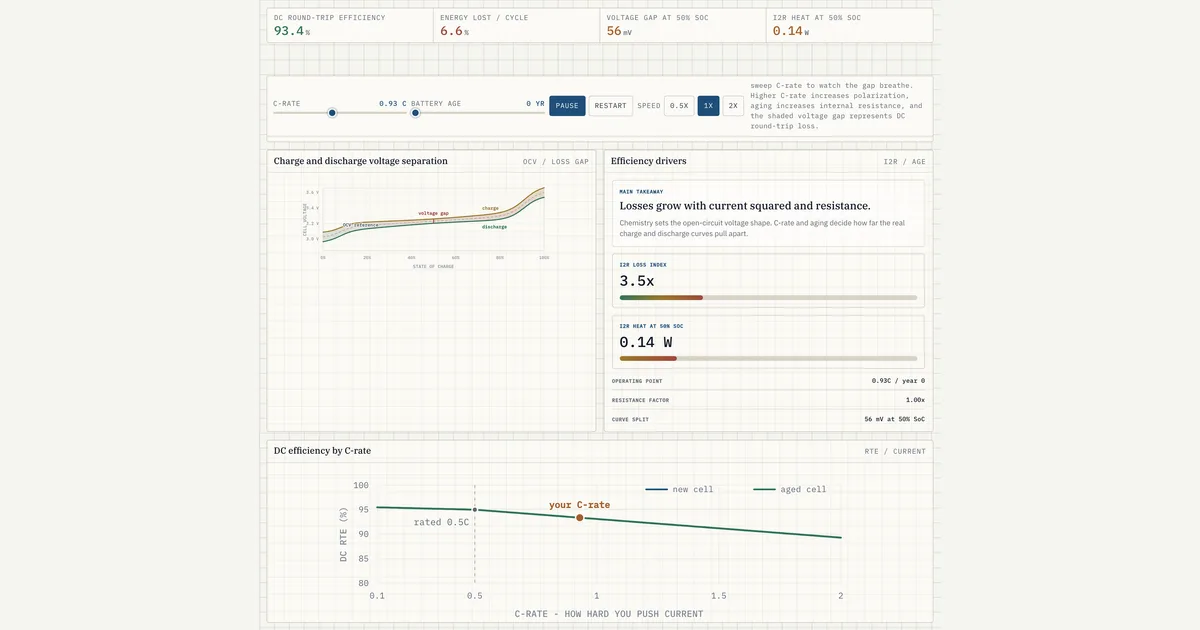
Every conductor, fuse, contactor and busbar is sized for that current, and resistive heating scales with current squared: doubling the C-rate doubles every amp figure and roughly quadruples the I-squared-R heat in cells, busbars and cabling. The extra heat raises auxiliary HVAC load, widens rack-to-rack temperature spreads and tends to accelerate degradation, which is why thermal design follows the continuous C-rate, not the average one.
Voltage stress follows from the same current through internal resistance: terminal voltage sits below open-circuit voltage by current times resistance on discharge, and above it on charge. A higher C-rate deepens the sag, so the cell reaches its low-voltage cutoff earlier in the discharge — the physical mechanism behind the datasheet footnote that deliverable energy shrinks at higher rates — while on charge the overshoot reaches the upper voltage limit sooner, forcing an earlier taper into constant-voltage and slowing the last part of the recharge.
The effective SOC window therefore narrows as the rate rises, and narrows further with age as resistance growth deepens the sag at the same amps; the highest-resistance cell sags first and trips the BMS limit for the whole string, the weakest-cell limitation. The PCS must ride this too: its VDC window has to cover the sagged string voltage at full current in the low-SOC, low-temperature corner, and at temperature extremes the BMS caps current outright — derating that pulls the achievable C-rate below nameplate.
Numbers
Key facts
| Definition | C-rate = power (MW) / energy (MWh); units of 1/h; run time in hours = 1 / C-rate |
|---|---|
| Duration map | 1C = 1 h, 0.5C = 2 h, 0.25C = 4 h, 0.125C = 8 h (invert to convert) |
| Typical utility-scale range | 0.25C to 0.5C dominant; ~1C and above mostly for frequency-response assets |
| Market decision rule | Sub-0.5C (2-4 h+) chases arbitrage and capacity revenue; ~1C+ targets ancillary and frequency services |
| Cell-level continuous rating | Modern high-energy LFP (280-314 Ah class) typically ~0.5C continuous, some warranted to 1C |
| Charge vs discharge | Often asymmetric; continuous charge frequently capped at 0.5C or below even where discharge is higher |
| Current arithmetic | Cell amps = C-rate x rated Ah: a 314 Ah cell carries 157 A at 0.5C and 314 A at 1C; a 5 MWh container moves roughly 1,900 A on its DC bus at 0.5C |
| Heat generation | Resistive losses scale with current squared: 2x the C-rate = roughly 4x the I2R heat |
| Voltage stress | Terminal voltage = OCV minus current x resistance on discharge (plus on charge); higher rates reach the voltage limits earlier, narrowing the effective SOC window |
| Aging creep | Constant MW on faded capacity raises effective C-rate: ~0.25C at BOL becomes ~0.3C at 80% remaining capacity |
| Reference point | Cell-level DC rate differs from the POI figure by PCS, transformer and auxiliary losses; warranties use the cell-level DC rate |
| Binding constraint | The warranted continuous cell-level rate governs sizing; a time-limited peak (e.g. 1C for 10 min) does not |
| Datasheet convention | Energy is declared at a stated rate and temperature, commonly 0.5C at 25 C; deliverable energy shrinks slightly at higher rates |
| Standards touchpoints | IEC 62619 / UL 1973 (cell and pack safety at declared rates), UL 9540 (ESS certification), UL 9540A (propagation test method), NFPA 855 (installation), NFPA 68/69 (deflagration) |
Typical values and standards
Most utility-scale LFP projects land between 0.25C and 0.5C, with 4-hour (0.25C) procurement dominant in California and increasingly Texas, and 2-hour (0.5C) common in the UK and Australia. Rates of 1C and above are mostly confined to frequency-response assets, and sustained operation much above 1C is rare in bulk storage because it forces specialized high-power cells that cost more per kWh.
Modern high-energy LFP cells in the 280 to 314 Ah class and larger are typically rated around 0.5C continuous, some warranted to 1C; NMC appears mainly in space-constrained cases and tolerates harder per-cell rates but carries a lower thermal-runaway onset.
No standard mandates a C-rate, but several depend on it. IEC 62619 and UL 1973 safety testing of cells and packs is performed at declared charge and discharge rates, so a certificate is valid only within them.
UL 9540 certifies the ESS product as configured, while UL 9540A, the fire and thermal-runaway propagation test method, characterizes a representative unit whose data feeds NFPA 855 installation rules, with deflagration protection per NFPA 68 and 69. Freeze the design C-rate early, because it propagates into PCS sizing, DC cabling and protection, HVAC tonnage, the augmentation schedule and the warranty a lender will underwrite.
In practice
Why it matters in a real grid-scale project
Because C-rate is the inverse of duration, it effectively sets how long the asset runs, and duration decides what market it can serve. Sub-0.5C, longer-duration systems of two to four hours and beyond chase energy arbitrage and capacity or resource-adequacy revenue; higher-C, short-duration systems around 1C and above target fast frequency response, frequency regulation and other ancillary services where MW matters more than MWh.
The revenue stack, and therefore the whole financial model, follows from this single ratio. That is why it is frozen at the very start of development, before the layout, the cell selection or the interconnection application are locked.
It also drives the bill of materials: the current and heat consequences above become DC cabling and protection ratings, busbar cross-sections and HVAC tonnage. Vendors warrant cells as a function of operating C-rate, so running above the warranted rate can erode or void coverage, and PCS-to-energy sizing must stay inside that envelope. A low-C system can use cheaper high-energy cells and lighter cooling, but ties up more MWh of capital per grid-facing MW.
How it shows up in specs, studies and contracts
On cell and DC-block datasheets, the stated energy is always declared at a specific discharge rate and temperature, commonly 0.5C at 25 degrees Celsius; the footnote matters because deliverable energy shrinks slightly at higher rates. Warranty documents are matrices, not single numbers: cycles or energy throughput guaranteed at a given C-rate, temperature band, SOC window and cycles per year.
Ask the vendor three questions: is the quoted rate continuous or a time-limited peak, is it symmetric between charge and discharge, and at what temperature is it valid. Many LFP products allow 0.5C discharge but cap continuous charge at 0.5C or lower, which limits how fast the asset can reload between market windows.
Interconnection studies and market registration deal in MW and MVA at the point of interconnection, not C-rate directly, but the tolling or capacity contract fixes both the MW and the MWh, and with them the C-rate, and usually obliges the owner to augment so deliverable energy holds through the term. Commissioning capacity tests demonstrate a full discharge at rated power, a C-rate test in disguise, and that measured number is what the contract is enforced against.
The binding constraint is the warranted continuous cell-level rate. Working checklist: confirm the denominator (nameplate versus usable, BOL versus EOL), the measurement point (DC, PCS terminals or POI), how auxiliary load is treated, and whether augmentation keeps the cell-level rate inside warranty for the full term.
Pitfalls
Common pitfalls
Two definitions circulate. Cell datasheets define C-rate as current over rated ampere-hour capacity, while system engineering defines it as power over energy. They diverge because cell voltage sags under load, so 1C in amps is not exactly 1C in watts, and the gap widens at higher rates and lower state of charge.
A related trap is a marketing sheet quoting a headline rate that is really a short peak, for example 1C for ten minutes, rather than the continuous rating. Only the continuous number sets duration and thermal design, so size and warrant against it and treat the peak as a momentary capability.
Do not read duration straight off the nameplate ratio either. Deliverable energy falls modestly as discharge rate rises, auxiliary consumption and conversion losses take their share, and the usable SOC window is narrower than the full nameplate. A 100 MW / 400 MWh system is a 0.25C, 4-hour asset on paper, but the hours actually contracted at the POI are limited by deliverable energy — usable energy net of losses — and that is what the capacity test measures. Nameplate is not usable, and beginning-of-life is not end-of-life; a plan that ignores either gap fails its own commissioning test.
Common misconception
A higher C-rate means a bigger or more capable battery.
In reality: A higher C-rate means a shorter-duration battery for a given energy capacity. It says how fast the energy is delivered, not how much there is. A 1C system empties in one hour; a 0.25C system of the same MW rating holds four times the energy and runs for four hours. If you want more capability, that usually means more MWh (lower C-rate), not a higher one.
Go further
Visuals & further reading
- Sizing a BESS: Power, Energy, Degradation & Augmentation Article
- Interactive: Cell Losses & Efficiency Interactive visual · bess.engineer
- Interactive: Lithium-Ion Cell Interactive visual · bess.engineer
- Internal resistance Glossary
- VDC window Glossary
- Derating Glossary
C-rate, in context.
The Grid-Scale BESS course covers C-rate — and the rest of the system — from the ground up, the way it actually gets deployed.