Black start
Reviewed October 2026 by Sergey Syrvachev
Black start is the capability to re-energize a section of a de-energized ("dead") grid without drawing power from the wider transmission system — starting from zero. Historically the service came from dedicated diesel- or hydro-started thermal units; it is increasingly delivered by a grid-scale BESS running its power conversion system in grid-forming mode, where the inverter establishes its own voltage and frequency reference instead of synchronizing to an existing source.
It is procured as a contracted system-restoration service, specified by the system operator in a grid code or bilateral agreement, with obligations on start time, reserved energy, load-pickup steps, and islanded endurance.
New to BESS? Start free in the Learn BESS hub — no cost, no account.
What it is (precise)
After a partial or total blackout, the network is rebuilt in stages: a black-start resource energizes a section of dead bus, holds a stable voltage and frequency reference on that island, then sequentially supplies cranking power for larger generating units and progressively connects load until the island can be resynchronized to the bulk grid. The defining requirement is that the resource needs no external supply to begin — it carries its own stored energy and its own voltage and frequency reference, and the start must be self-contained down to the auxiliary systems that wake the plant up.
For a BESS, the energy is already in the racks and the reference comes from the PCS. A grid-following inverter cannot do this, because it needs an existing grid voltage to lock onto. A grid-forming inverter, by contrast, behaves as a controllable voltage source behind an impedance, so it can build an islanded grid from a dead start, supply limited inrush and fault current — enough, combined with soft energization, to bring transformers and motors online — and accept the inherently unbalanced, lumpy load steps of a restoration sequence.
Grid-forming inverters are also particularly good at soft energization, which they perform natively and precisely in firmware; synchronous black-start units can approximate it by ramping generator excitation while connected to the dead network, but the inverter's voltage control is finer and faster.
Instead of closing a breaker onto a dead transformer and absorbing a magnetizing inrush of typically 6 to 12 times rated current, the inverter ramps the island voltage from zero to nominal over several seconds, magnetizing every connected transformer and cable gradually with almost no inrush. This lets a comparatively small battery energize network sections that would otherwise demand a much larger rotating machine, and it is one of the strongest technical arguments for BESS-based restoration.
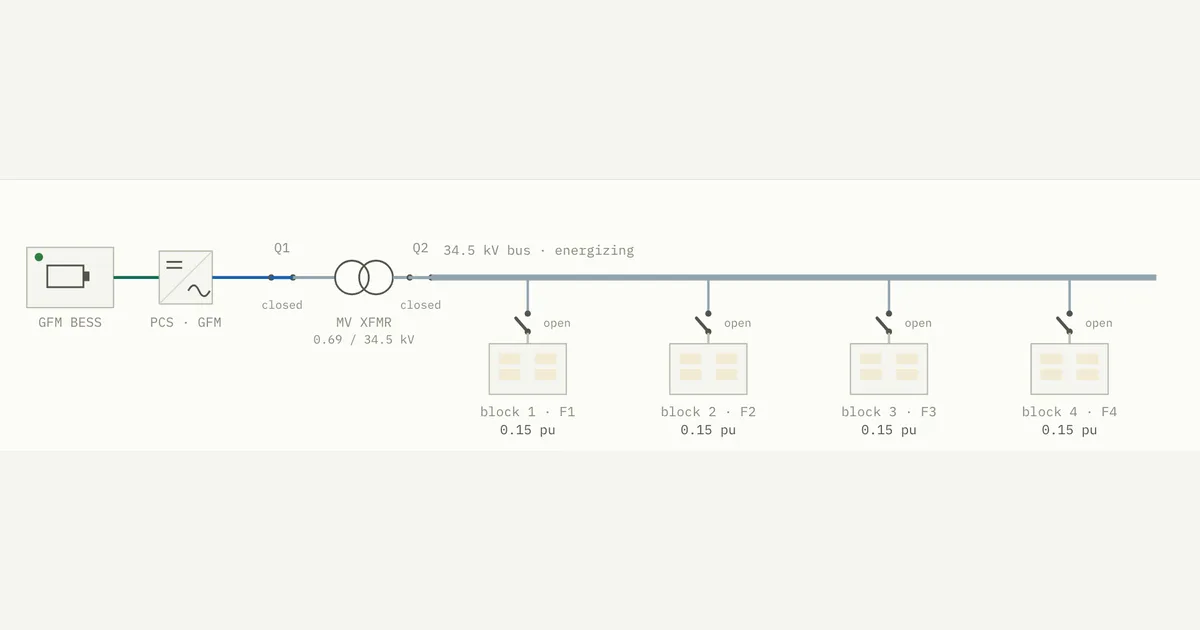 Interactive · bess.engineer ↗
 Numbers
Key facts
| Required PCS control mode | Grid-forming (voltage-source); grid-following cannot black start |
|---|---|
| GFM fault-current contribution | Typically ~1.1–1.5× rated current, short duration (vs ~5–7× for a synchronous machine) |
| Transformer energization inrush | ~6–12× rated current if closed direct; near zero with GFM soft-energization voltage ramp (seconds) |
| Cranking power for a thermal unit | Roughly 5–10% of the unit's rating (station auxiliaries) |
| Reserved energy | Ring-fenced SOC block for hours-to-days of restoration, set by contract/grid code; net usable energy, not nameplate |
| Contracted start & endurance | GB tenders: typically energize the first dead section within ~2 h of instruction and sustain the island on the order of 10 h (or several sequential starts) |
| Performance spec source | System-operator grid code / bilateral contract (ENTSO-E Emergency & Restoration code in the EU; NERC EOP-005 in North America) |
| GB benchmark | Electricity System Restoration Standard sets regional restoration milestones on a tens-of-hours timescale |
| First utility-scale BESS demo | 2017 — a California BESS black-started a gas turbine; GB and Australian operators have since contracted GFM battery plants |
| Proving tests | Periodic capability tests, commonly between annual and every few years, with availability penalties |
| Study type | EMT (electromagnetic transient) simulation of the full energization sequence, not load flow |
Typical values and standards
Useful anchors from real projects: grid-forming fault-current contribution is typically about 1.1 to 1.5 times rated current for short durations, set by semiconductor limits rather than machine physics — roughly a quarter to a fifth of a synchronous machine's 5 to 7 times. Direct transformer energization draws roughly 6 to 12 times rated current, which soft energization largely avoids.
Cranking power for a thermal unit's auxiliaries is commonly around 5 to 10 percent of that unit's rating, so a 100 MW-class BESS can plausibly crank a much larger plant. Reserved energy is contract-specific, but restoration plans assume hours of islanded operation before resynchronization.
There is no single global black-start standard; the performance specification lives in the system operator's framework. In Europe that is the ENTSO-E network code on Emergency and Restoration; in North America, NERC EOP-005 governs system restoration from black-start resources; Great Britain adds an Electricity System Restoration Standard with regional restoration milestones measured in tens of hours.
IEEE 2800 sets general performance for transmission-connected inverter-based resources but does not itself define black start, while EPRI, NERC and ESIG guidance is converging on what grid-forming behavior must demonstrate: voltage-source response, fault-current contribution, and stable islanded operation.
Black start adds no new safety-code obligations: the plant simply carries the standard stationary-storage regime — the UL 9540 ESS safety certification (the listing NFPA 855 requires), UL 9540A fire-propagation test data feeding NFPA 855 compliance, and NFPA 68/69 for deflagration protection. The black-start-specific numbers live in the tender instead.
GB restoration tenders have typically required a resource to energize its first dead network section within a couple of hours of instruction and to sustain the island for on the order of ten hours, or to deliver several sequential start attempts; Australian (AEMO) system-restart contracts impose comparable start-time and endurance obligations, with the exact figures set per region.
In practice
Why it matters in a real grid-scale project
Black start is a system-restoration service that grid operators procure under contract, so it is a revenue stream — usually availability payments plus tested-capability terms — and sometimes a connection requirement rather than an optional extra. A BESS that can credibly provide it stacks black-start and island-forming capability on top of energy arbitrage and frequency response, which improves the commercial case at the point of interconnection without consuming many cycles, since the service is exercised rarely but paid for continuously.
The engineering consequence is decided early, because it touches the PCS firmware and controls (true grid-forming control, not merely GFM-capable hardware), the protection scheme, and the energy reservation policy. Restoration can take hours to days, so a defined block of state-of-charge must be ring-fenced and unavailable for trading. Energizing transformers and starting large motors demands high inrush and fault current that the inverters and DC system must be rated to deliver, and the controls must ride through the resulting voltage and frequency excursions without tripping.
The service has also moved from pilot to procurement. A California BESS black-started a gas turbine in 2017 in one of the first utility-scale demonstrations, the UK's Distributed ReStart programme trialled restoration from distribution-connected resources, and system operators in Great Britain and Australia have since awarded restoration contracts to large grid-forming battery plants. For developers, that history matters: operators now have reference projects and expect bidders to demonstrate comparable, study-backed capability rather than paper claims.
How it shows up in specs, studies and contracts
On a PCS datasheet, look past the marketing line "grid-forming capable." Check whether islanded and dead-bus-energization operation is a released firmware function, what overload and fault current the unit delivers and for how long (magnitude and duration both matter to protection), how much unbalanced and non-linear load it tolerates, and its harmonics performance while energizing cables and transformers. Four-quadrant operation matters because restoring lightly loaded cable networks means absorbing capacitive reactive power, not just injecting.
In studies, black start is an EMT-level exercise, not a load-flow one. Expect electromagnetic-transient simulation of the full restoration sequence: energization of each transformer and cable section, motor starts, load-block pickup, and resynchronization at the point of interconnection. Protection deserves special attention — an inverter island produces far less fault current than the bulk grid, so overcurrent relays graded for normal grid-connected conditions may simply not see faults, forcing voltage-based or differential schemes for the restoration path.
Contractually, ask what availability percentage is required and how it is tested (periodic proving tests, commonly somewhere between annual and every few years), how much energy must be held in reserve and how that interacts with trading, how long the island must be sustained, and who supplies the plant's own auxiliary power when the grid is dead. Payment is typically an availability fee with penalties for failed tests, so the warranty and control-software commitments behind the capability carry real money.
Pitfalls
Common pitfalls
The most common trap is conflating GFM-capable hardware with a validated black-start function. Many modern inverters can run grid-forming control while connected to a live grid, yet have never demonstrated dead-bus energization, load-step rejection (riding through the sudden loss of a picked-up load block), or hours of autonomous islanded operation.
A related one is the auxiliary-power blind spot: HVAC, controls, and battery management keep drawing power during a blackout, so the site needs a self-supply path (UPS plus self-feed from the DC side, or a small generator) to remain start-ready — a plant whose auxiliaries die with the grid cannot black start.
Two more trip-wires: energy accounting and event survival. Ring-fenced restoration energy is usable energy at the delivery point, net of conversion losses and the usable SOC window, not nameplate — and it must still be there after weeks of standby. And during restoration the island will see voltage and frequency excursions far outside normal bands, so ride-through settings tuned for bulk-grid compliance can trip the plant off exactly when it is the only source; restoration control modes need their own, wider protection envelope.
Common misconception
Any BESS that can island or run off-grid can provide black start.
In reality: Islanding capability is necessary but not sufficient. Black start requires a true grid-forming PCS that creates its own voltage and frequency reference from a dead start, sized to supply transformer inrush and motor-starting current, plus a contractually reserved block of energy, a self-supplied auxiliary system that survives the blackout, and controls validated by EMT study and proving tests against the system operator's restoration sequence. A grid-following inverter, even on a BESS at full state of charge, cannot black start because it needs an existing grid to synchronize to.
Go further
Visuals & further reading
- Interactive: Black Start from a GFM Battery Interactive visual · bess.engineer
- Interactive: Grid-Forming Droop Interactive visual · bess.engineer
- Interactive: GFM Current Saturation Interactive visual · bess.engineer
Black start, in context.
The Grid-Scale BESS course covers black start — and the rest of the system — from the ground up, the way it actually gets deployed.