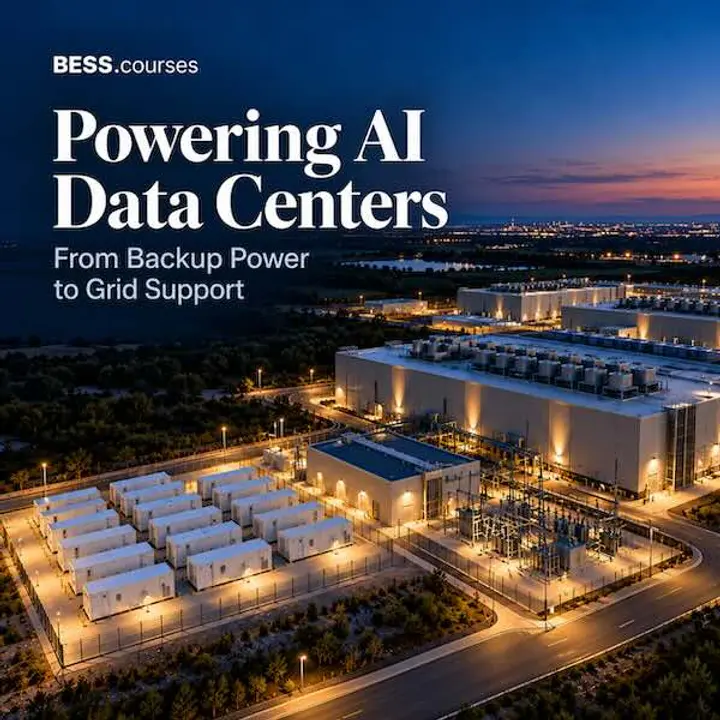
Powering AI Data Centers: BESS, UPS & Grid Integration
Self-paced video course · In production · by the end of November 2026 · 7 modules · 20 lectures · 3h planned
For engineers entering the data-center market, BESS and UPS product and sales teams, developers, consultants and procurement specialists. Assumes basic familiarity with electrical power, energy and AC/DC systems; no data-center design experience. Who it's for
Delivered complete by the end of November 2026. Full refund any time until release, then within 7 days of release, provided less than half the course has been completed. How the refund works → In the EU, the EEA and the UK, you can withdraw within 14 days of buying for a full refund, whatever you have watched: see Refunds.
Buying for a team? Contact us
or
Double conversion, and an AI load swing.
The double-conversion scheme, one of the four site BESS integration schemes the course compares, and a simulation of an AI load at the point of interconnection, without and with an AI UPS.

Instructor: Sergey Syrvachev Director of Product Engineering, HyperStrong
From backup power to grid support.
AI data centers need continuous power, access to capacity and infrastructure that can handle rapid changes in computing demand. Battery energy storage systems (BESS) can help, but their value depends on where they connect, how they are controlled and which loads they protect. This course gives you an overview of the power challenges data centers face, and a practical framework for comparing those choices.
In 3h of lectures, you will follow the power path from the utility connection to the GPU rack. You will learn how switchgear, transformers, uninterruptible power supplies (UPS), generators and cooling systems work together, and why IT load, total facility load and protected load are different quantities. You will also see how rising rack density and the search for earlier power availability are changing project decisions.
The course explains reliability through both equipment and behavior. You will distinguish redundant capacity from independent power paths, examine N, N+1, 2N and distributed redundancy, and follow a utility outage through battery support, generator pickup and recovery. A concise standards overview separates Uptime Tier classifications from TIA-942 infrastructure requirements and ASHRAE thermal guidance.
Next, you will examine synchronized AI load swings and their effects on the grid and on-site generation, and weigh the options: software controls, rack capacitors, battery backup units, UPS-based smoothing and site BESS. Grid-following and grid-forming controls are introduced through their functions and operating limits.
The commercial discussion connects technical choices with time to power, capital cost, operating duty and potential grid-service value. The final architecture section introduces 800 VDC, sidecar power racks and solid-state transformers as the next steps in how these solutions are developing.
Level
Practical foundation with intermediate worked examples.
A knowledge check in every lecture
Each of the 20 lectures ends with a knowledge check, listed under it below. The last lecture returns to the 120 MW protected-load example in six case-based questions, revealing the reasoning after each.
20 lectures, from the power problem to 800 VDC.
The course follows the power problem, equipment and reliability requirements before comparing BESS functions, integration choices and emerging DC architectures.
20 lectures · 3h planned
Modules open one at a time, or all at once; find in page (Ctrl+F or ⌘F) still searches every lecture title.
-
- 1 Why AI changes the data-center power problem 6 min
Knowledge check: Identify which problem is about capacity, which is about continuity and which is about rapid changes in demand.
- 2 Time to power, flexible connections and on-site generation 8 min
Knowledge check: Explain who supplies the gap when a connection permits less import than the facility needs.
- 1 Why AI changes the data-center power problem 6 min
-
- 3 Follow the power from the grid to the GPU 8 min
Knowledge check: Mark the IT-load boundary and the wider protected-load boundary on one power path.
- 4 UPS batteries and generators through an outage 13 min
Knowledge check: Narrate utility loss, battery support, generator pickup and return to normal operation.
- 5 Cooling, PUE and the load that must stay alive 8 min
Knowledge check: Explain why backup sizing cannot use IT MW alone or assume every cooling load has identical ride-through needs.
- 3 Follow the power from the grid to the GPU 8 min
-
- 6 Uptime, TIA-942, ASHRAE and what Tier ratings mean 8 min
Knowledge check: Explain why N+1 equipment and a quoted availability percentage do not establish Tier III.
- 7 Redundant capacity, independent paths and outage behavior 10 min
Knowledge check: Take one component out of service and decide whether the load still has sufficient capacity and a working path.
- 6 Uptime, TIA-942, ASHRAE and what Tier ratings mean 8 min
-
- 8 AI load swings and their impact on the grid 10 min
Knowledge check: Identify the relevant disturbance and measurement boundary for three load-change examples.
- 9 Grid requirements and four ways to manage AI swings 7 min
Knowledge check: Choose which layer should address a fast rack transient and which layer manages the site import profile.
- 10 PCS control, smoothing, ride-through and generator bridging 10 min
Knowledge check: Explain what evidence is missing when a proposal says only that its PCS is grid-forming.
- 11 Backup reserves, grid services and the commercial case 9 min
Knowledge check: Determine which services remain possible when SOC is near the backup floor or upper limit.
- 12 Battery technology, safety and warranted operating duty 5 min
Knowledge check: Identify the duty and safety evidence to request before accepting a vendor’s battery-life claim.
- 8 AI load swings and their impact on the grid 10 min
-
- 13 Power modules and distributed redundancy 9 min
Knowledge check: Under the illustrated balanced dual-feed mapping, check the 6.6 MW load after one 2.4 MW module is unavailable, then explain why losing two modules is different.
- 14 Compare four site BESS integration schemes 10 min
Knowledge check: Shortlist a scheme for a grid-connected site and an islanded site, stating the assumptions that could change each choice.
- 15 Worked example from protected load to MW, MWh and MVA 15 min
Knowledge check: Explain why 48.8 MWh and 250 MWh answer different sizing constraints, and why 123.6 MWh is not always available for dispatch.
- 16 UPS smoothing, rack capacitors and battery backup units 11 min
Knowledge check: Choose the layer that fits the required timescale and identify the loads it actually protects.
- 17 From supplier proposal to acceptance testing 8 min
Knowledge check: Turn one generic supplier promise into a test with an operating condition, measurement boundary and pass criterion.
- 13 Power modules and distributed redundancy 9 min
-
- 18 Why 800 VDC changes the power architecture 7 min
Knowledge check: Calculate the ideal DC current at 1 MW and 800 V, then state one practical limitation not captured by that calculation.
- 19 SSTs, DC protection and storage on the DC bus 8 min
Knowledge check: Identify the architecture, grounding and protection questions that must be resolved before an 800 VDC concept becomes a project.
- 18 Why 800 VDC changes the power architecture 7 min
-
- 20 Final case review and knowledge check 10 min
Knowledge check: Complete the six-question case check: four minutes of guided pauses and six minutes of answer explanation.
- 20 Final case review and knowledge check 10 min
Lengths are the course plan’s, in minutes.
All 20 lectures and their knowledge checks are planned in full. Pre-order this course
What you will be able to do.
Trace a grid-to-rack power path and distinguish IT load, facility load and the load that must remain protected.
Explain the separate roles of UPS systems, generators, PCS, site BESS, rack capacitors and battery backup units.
Distinguish redundancy counts from independent supply paths, maintenance capability and Tier certification.
Interpret AI load swings and identify the power, energy and converter-current limits.
Compare power modules, site BESS schemes, UPS smoothing and rack buffering for a stated requirement.
Check backup reserves and charging headroom before assigning spare capacity to smoothing or grid services.
Explain how 800 VDC changes power conversion, storage placement and protection questions.
Identify vendor information and know which major vendors supply the power equipment.
The final case, in six questions.
Lecture 20 connects sizing, reserve, supply paths, control limits, commercial value and acceptance evidence. A longer written recommendation is optional practice.
Why does the 120 MW case produce both a 48.8 MWh energy bound and a 250 MWh power screen?
At 80% SOC in the illustrative 10–90% window, what reserve and charging room remain?
Why do spare modules alone not prove concurrent maintainability?
Does a grid-forming PCS establish uninterrupted service through every grid event?
Which benefits can be credited to the BESS commercial case?
What would turn a backup-duration claim into an assessable acceptance requirement?
Who it is for.
Electrical and energy-storage engineers entering the data-center market.
BESS, UPS and power-equipment product managers and technical sales teams.
Data-center developers, project managers and commercial teams assessing power options.
Energy consultants and procurement specialists reviewing supplier proposals.
Built for engineers, project developers, product managers, technical sales teams and commercial professionals, the course combines system explanations and decision exercises. You will finish better prepared to compare proposals, identify missing assumptions and discuss requirements with customers, utilities and equipment suppliers.
Before you begin
Basic familiarity with electrical power, energy and AC/DC systems is helpful. No data-center design experience is required. Short worked examples use arithmetic and a square root; a calculator is sufficient. Acronyms are introduced as they appear.
Related deep dives: BESS Engineering Foundations for the electrical model under the sizing — DC and AC fundamentals, P-Q capability and MVA headroom — and How a Battery Gets Paid for the revenue stack behind grid services. The Grid-Scale Complete Guide supplies the wider system picture if you are new to BESS. Free reading: Why Megawatts Are Not Enough: Sizing a BESS for AI Load Ramps.