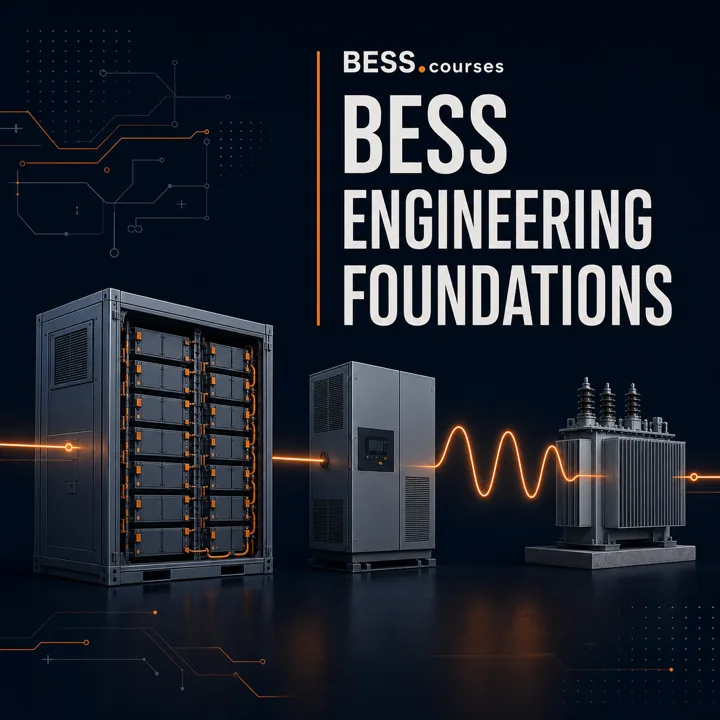
BESS Engineering Foundations.
From battery physics to grid operation. BESS projects fail at the engineering level when the team doesn’t understand what is actually happening between the cell and the grid — this course closes that gap with physics and electrical laws, not vendor marketing.
Your course space opens at purchase in your training.bess.courses classroom — the finished course lands there complete, not as a drip of sections, by the end of October 2026. Full refund any time until release, then within 7 days of release, provided less than half the course has been completed.
Student or early-career engineer? The Complete Guide is free for you, and every specialist course and the bundle are 50% off. The student discount does not combine with any other discount, early bird included. How to claim it
This is a separate specialist course, not a section of the Complete Guide the same instructor sells on Udemy. What differs
Secure checkout by Stripe — card, Apple Pay and Google Pay. The lines under each price say whether tax is included and, where we can estimate it, about what Stripe will show in your own currency.
For engineers entering BESS from any background. Assumes nothing: it starts from first principles. Who it's for
Company paying? We can invoice your employer — email sergey@bess.courses with the course and your company name. After your company's paperwork, the invoice arrives by email within 24 hours, due in 30 days; access starts as soon as it is sent.
This course is still in production: refundable in full until release, and for 7 days after if less than half is completed. Certificate: decided and announced at release. How the refund works →
One-time purchase with lifetime access — no subscription. Your access link arrives by email within minutes of payment and opens your course space. The email you enter at checkout receives the access link and becomes the student account — buying for someone else? Enter their email at checkout. Already a student? Use the email you sign in with.
Already bought it? Open your classroom
Watch the introduction.
What the course covers, who it serves and how it is taught — from the instructor.
One idea carries the whole course.
Current is the hidden enemy. Once that lands — heat, I²R losses, voltage drop — every later topic inherits from it: cable sizing, C-rate, transformer copper loss, resistance growth in ageing, PCS efficiency, and finally round-trip efficiency as the sum of every loss in the chain.
- Sections 1–4Fundamentals: the language of energy and power, the electrical toolkit in DC and AC, the battery and how it ages.
- Lectures 5.1–5.3The level shift, acknowledged out loud — the course tells you when it gets harder.
- Sections 5–8The AC world: PCS, three-phase, transformers, POI, then P-Q capability and four-quadrant operation.
- Sections 9–10Round-trip efficiency as the integration point where every earlier loss reappears.
All 99 lessons, section by section.
Each of the ten core sections closes with a quiz rather than deferring everything to one capstone few students finish (section 11 is supplementary). Worked examples sit inside the sections that introduce the concepts — the 5 MWh container you build in section 3 is the same one you operate later.
01 BESS language: energy, power, MW, MWh and duration Why a “100 MW battery” is an incomplete spec — and what an engineer says instead.
- 1.1 Course introduction: what this engineering foundation will unlock
- 1.2 Energy vs power vs matter: the physics every BESS engineer needs
- 1.3 Energy transformation and why losses always become heat
- 1.4 MW vs MWh vs duration: reading a BESS spec like an engineer
- 1.5 Bridge: why BESS ratings are never one number
- 1.6 Section quiz: energy, power and rating logic
02 Voltage, current, resistance, heat, and AC/DC The full electrical toolkit — DC and AC fundamentals, plus current as the hidden enemy.
- 2.1 Voltage, current and resistance explained with the water analogy
- 2.2 DC power: why P = V × I is the most useful equation in BESS
- 2.3 How resistance becomes heat — and why that heat matters
- 2.4 Current is the hidden enemy, part 1: heat and I²R losses
- 2.5 Current is the hidden enemy, part 2: voltage drop and consequences
- 2.6 Worked example: same MW at 1000 VDC vs 1500 VDC — cable loss comparison
- 2.7 AC vs DC: why both live in a BESS
- 2.8 AC fundamentals: sine wave, frequency, phase and RMS
- 2.9 Section quiz: electrical fundamentals (DC and AC)
03 Battery architecture and operating window How a cell becomes a 5 MWh container — and how that container is actually used.
- 3.1 From cell to module to rack to container: BESS architecture tour
- 3.2 Series connection: how voltage stacks up in a battery pack
- 3.3 Parallel connection: how current and capacity add
- 3.4 Building a 5 MWh container step by step from a single cell
- 3.5 C-rate: how fast a battery can be charged or discharged
- 3.6 SOC: how full the battery is right now
- 3.7 DOD: how deep each cycle goes — and why it matters
- 3.8 SOH: how aged the battery is and how that limits capability
- 3.9 Bridge: PCS DC voltage window — Vdc_min and Vdc_max explained
- 3.10 Bridge: nominal energy vs usable energy vs contract energy
- 3.11 Worked example: 10–90% SOC window on the 5 MWh container we just built
- 3.12 Section quiz: battery architecture and operating window
04 Degradation, resistance growth and end of life What an aging curve actually promises — and what it deliberately leaves out.
- 4.1 What a degradation curve actually means (and doesn’t)
- 4.2 Capacity fade vs usable energy: the boundary question
- 4.3 Three things degrade and the resistance growth behind them
- 4.4 The shape of degradation: initial drop, steady phase and the knee
- 4.5 One battery, many curves: how operating profile changes lifetime
- 4.6 Calendar vs cycle aging: the two clocks (and why a parked battery still ages)
- 4.7 Reading vendor degradation curves critically
- 4.8 Overbuild vs planned augmentation: two lifetime strategies
- 4.9 Bridge: how degradation changes usable energy and RTE over life
- 4.10 Section quiz: degradation and end of life
05 AC interface: PCS, three-phase power, transformers and POI The grid side of BESS — opens with a level shift, ends with verification on site.
- 5.1 Foundations recap: what you know before we shift gears
- 5.2 From here the course gets harder: what’s about to change
- 5.3 DC vs AC in a BESS: where reactive power actually lives
- 5.4 BESS one-line architecture: battery to PCS to transformer to POI
- 5.5 Single-phase systems and BESS auxiliary loads
- 5.6 Why three-phase exists: smoother power, less conductor
- 5.7 Three sources 120 degrees apart: the heart of three-phase
- 5.8 Phasors: the language of every grid study you’ll read
- 5.9 Wye and delta configurations explained
- 5.10 The √3 relationships you actually use
- 5.11 Worked example: 690 V to 34.5 kV step-up transformer
- 5.12 Practical issues: unbalance, harmonics, grounding and phase rotation
- 5.13 Verify before energizing: five checks every engineer should run
- 5.14 Section quiz: AC interface and transformers
06 P, Q, S, power factor and MVA headroom Where the inverter datasheet starts making sense.
- 6.1 Real, reactive and apparent power: P, Q and S explained
- 6.2 Resistive, inductive and capacitive loads: the physics of reactive power
- 6.3 Power factor and the power triangle
- 6.4 Why BESS engineers care about MVA, not only MW
- 6.5 Worked example: PCS MVA headroom calculation
- 6.6 Where P, Q and S are measured: PCS, MV bus and POI
- 6.7 Bridge: from the power triangle to the P-Q curve
- 6.8 Section quiz: power triangle and MVA headroom
07 P-Q curve foundations Per-unit, the P-Q plane, the MVA circle and sign conventions — the theory before the quadrants.
- 7.1 Why four-quadrant operation matters for a BESS project
- 7.2 The per-unit system: what it is and why we use it
- 7.3 Why per-unit matters specifically for BESS projects
- 7.4 The P-Q plane and the MVA capability circle
- 7.5 Sign conventions: inverter-side vs grid-side pitfalls
- 7.6 Leading vs lagging power factor — and why engineers disagree
- 7.7 Section quiz: P-Q plane and conventions
08 Four-quadrant BESS operation The four quadrants in practice — what each one means, what it earns, what goes wrong.
- 8.1 Quadrant 1: discharge + reactive injection
- 8.2 Quadrant 2: charging + reactive injection
- 8.3 Quadrant 3: charging + reactive absorption
- 8.4 Quadrant 4: discharge + reactive absorption
- 8.5 Auxiliary loads and the POI capability envelope
- 8.6 Practical implications for BESS project design
- 8.7 Five common mistakes on the P-Q plane
- 8.8 Section quiz: four-quadrant operation
09 RTE foundations: boundaries, gross/net, one-way vs round-trip The mental model and definitions before the loss calculation begins.
- 9.1 Why round-trip efficiency matters for BESS projects
- 9.2 The boundary question: where is RTE actually measured?
- 9.3 Gross vs net RTE: why two vendors can both be “right”
- 9.4 Bad question vs better question: pinning down RTE
- 9.5 One-way efficiency vs round-trip efficiency
- 9.6 AC vs DC RTE: a quantitative example
- 9.7 Section quiz: RTE mental model
10 BESS losses, RTE calculation and lifetime effects Every loss in the chain, the stack calculation, and what happens over 20 years.
- 10.1 The loss map: a waterfall from grid to grid
- 10.2 Battery efficiency: coulombic and voltage combined
- 10.3 Self-discharge and standby losses in BESS
- 10.4 PCS efficiency curve: why peak efficiency misleads you
- 10.5 Transformer losses: core loss vs copper loss
- 10.6 Cable losses: MV collection and DC path together
- 10.7 Auxiliary loads: HVAC, BMS and why utilization matters
- 10.8 RTE sensitivity: operating point and over life
- 10.9 The stack calculation methodology
- 10.10 Worked example: 100 MWh in — how much comes out?
- 10.11 Final summary: what every BESS engineer should remember
- 10.12 Section quiz: losses, RTE calculation and lifetime
11 Bonus: grid context, project structure and recap Industry context as supplementary material — deliberately at the end, so it never dilutes the engineering.
- 11.1 How the grid is structured: generation, transmission, distribution
- 11.2 Customer types and who buys what
- 11.3 How a BESS project is structured and who does what
- 11.4 The abbreviations you will meet on day one
- 11.5 Glossary of the engineering terms used in this course
- 11.6 Course recap: the mental models worth keeping
99 lessons across 11 sections. Every section is listed here in full — nothing is hidden until purchase.
73 of the 99 lessons are drafted; 26 are still to write. Buy this course →
Built for engineers entering BESS from any background.
| If you are… | …you will leave able to |
|---|---|
| An early-career electrical engineer entering BESS | Read any BESS spec or vendor proposal with confidence — and ask the right follow-up question when something is missing. |
| A mechanical, controls or software engineer crossing into BESS | Build a working electrical mental model of a BESS without going back to a power-systems textbook. |
| A project engineer or developer | Recognise the engineering decisions behind sizing, losses, degradation and grid-code compliance — and which ones drive real cost. |
| A product manager or commercial lead | Hold informed technical conversations with your engineering team without bluffing on fundamentals. |
| A student or career-switcher targeting energy storage | Walk into BESS interviews with the vocabulary, frameworks and worked examples to demonstrate engineering literacy. |
Prerequisites: none — the course starts from first principles and stands alone. New to BESS? The Grid-Scale Complete Guide gives the full system picture first and is the recommended starting point; this course then goes several times deeper on the electrical layer.
Deliberately narrower than most BESS courses.
- Spend hours on cell chemistry and electrochemistry Treats the cell as an electrical device (V_oc + R_int) — chemistry only where it changes an electrical parameter
- Mix marketing, vendor pitches and engineering in one feed Pure engineering: physics, Ohm’s law, AC power, transformers, P-Q, RTE
- Show formulas without saying when an engineer actually uses them Every concept paired with the engineering decision it informs — sizing, compliance, losses, lifetime
- Treat RTE as a single number on a datasheet Treats RTE as the result of every loss in the chain — the natural integration point at the end
- End with a long capstone project few students finish No capstone. Worked examples sit in the sections that introduce the concepts — cable loss at 1500 VDC, the 10–90% SOC window, the 690 V step-up, MVA headroom, and the full 100 MWh loss stack
What this course does not cover.
Saying this up front is part of the deal. If you need one of these, this is not the course — and several of them are covered properly elsewhere on the learning path.
- Cell electrochemistry and battery materials science — chemistry is named, not taught
- Project finance, IRR modelling, revenue stacking and market structures
- Detailed safety engineering, fire suppression and thermal-runaway propagation
- Specific OEM products, vendor selection or procurement processes
- Software development, SCADA/EMS implementation and communications protocols
Fire safety and thermal runaway have their own dedicated course; project economics and the revenue stack are covered in How a Battery Gets Paid.
Not out yet — but the core course is.
This engineering deep dive is in production — buy it now, refundable in full until release and for 7 days after. Meanwhile the complete Grid-Scale BESS course is available now and covers the full system end to end.
Related deep dives: How a Battery Gets Paid prices the losses this course explains, and BESS Warranties, LTSA & Performance Testing turns the RTE boundary of section 9 into a contractual one.