Frequency response FFR / FR
Reviewed October 2026 by Sergey Syrvachev
Frequency response is the rapid, automatic injection or absorption of real power to counter deviations of grid frequency from its nominal 50 or 60 Hz. In a grid-scale BESS the power conversion system measures frequency locally and slides active power along a defined frequency-to-power curve, acting within a fraction of a second to a few seconds.
The family runs from fast frequency response (FFR) and synthetic inertia in the sub-second range, through primary droop-based containment over seconds, up to slower secondary regulation. You meet it three times: as a P(f) line on a PCS datasheet, as a RoCoF-withstand value in an interconnection study, and as a paid product in a market rulebook. Batteries dominate because they act ten to a hundred times faster than thermal-plant governors.
New to BESS? Start free in the Learn BESS hub — no cost, no account.
What it is (precise)
Grid frequency is the real-time indicator of balance between generation and load across a synchronous AC system: lose a large generator and frequency falls, lose a block of load and it rises. How fast it moves — the rate of change of frequency, or RoCoF — historically depended on the stored kinetic energy of spinning machines.
Frequency response is the controlled real-power action that opposes the deviation: the BESS discharges into a low-frequency event and charges to absorb a high-frequency one. The delivered quantity is active power in MW, measured at a contractually defined reference point, usually the point of interconnection — not at the battery terminals, a distinction that costs real MW.
The service family spans a spectrum of speed. Fast frequency response and synthetic inertia act sub-second to slow RoCoF and lift the frequency nadir; primary frequency response follows a droop curve over seconds to arrest and hold the deviation; secondary regulation then restores frequency over minutes. How the response is produced depends on control mode.
A grid-following PCS measures frequency through a phase-locked loop and then commands a power change, while a grid-forming inverter responds inherently through its droop characteristic without waiting for a measurement — which is why GFM assets are increasingly favoured for inertia-like products, where the first hundred milliseconds decide how deep the nadir goes.
Every proportional product is the same three-segment control law, and reading it in that shape is what makes otherwise incomparable rulebooks comparable. Inside a deadband around nominal the plant holds its schedule and delivers nothing. Outside it, active power follows a straight line whose steepness is the droop setting — the general form of that law, its per-unit algebra and its grid-forming variant belong to the P-f droop entry.
Beyond the full-activation deviation the line saturates at the contracted MW and has to stay there for the sustain period. Deadband, slope and saturation point are three independent settings, and a service specification pins all three plus the time allowed to travel the ramp; a converter that implements the slope alone will bench-test perfectly and fail prequalification.
Why it matters in a real grid-scale project
As synchronous generation retires, system inertia falls and events become faster and deeper — Ireland and South Australia already operate against explicit RoCoF constraints, and ERCOT has run at record-low inertia. Operators therefore procure dedicated fast products: GB Dynamic Containment (DC-L and DC-H), ERCOT Fast Frequency Response inside Responsive Reserve, AEMO contingency FCAS including the 1-second Very Fast service, and continental FCR under ENTSO-E rules.
For many batteries these services are a primary revenue stream, usually stacked with energy arbitrage, and price saturation of these shallow, capacity-limited markets is a standard downside case in the project financial model that a student should expect to see stress-tested.
The engineering consequences are concrete. The duty is power-intensive but short-energy, so it shapes C-rate, PCS sizing, and the inverter's headroom for fast power steps rather than total MWh. It drives thermal and auxiliary loads, erodes round-trip efficiency through frequent shallow cycling, and sets state-of-charge rules so the asset can deliver both upward (discharge) and downward (charge) response on demand.
In daily operation, SoC-recovery strategy and the availability and penalty clauses in the grid-service contract dominate far more than the raw power rating: an asset parked at full SoC can still earn a symmetric product on paper yet be physically unable to deliver its downward half.
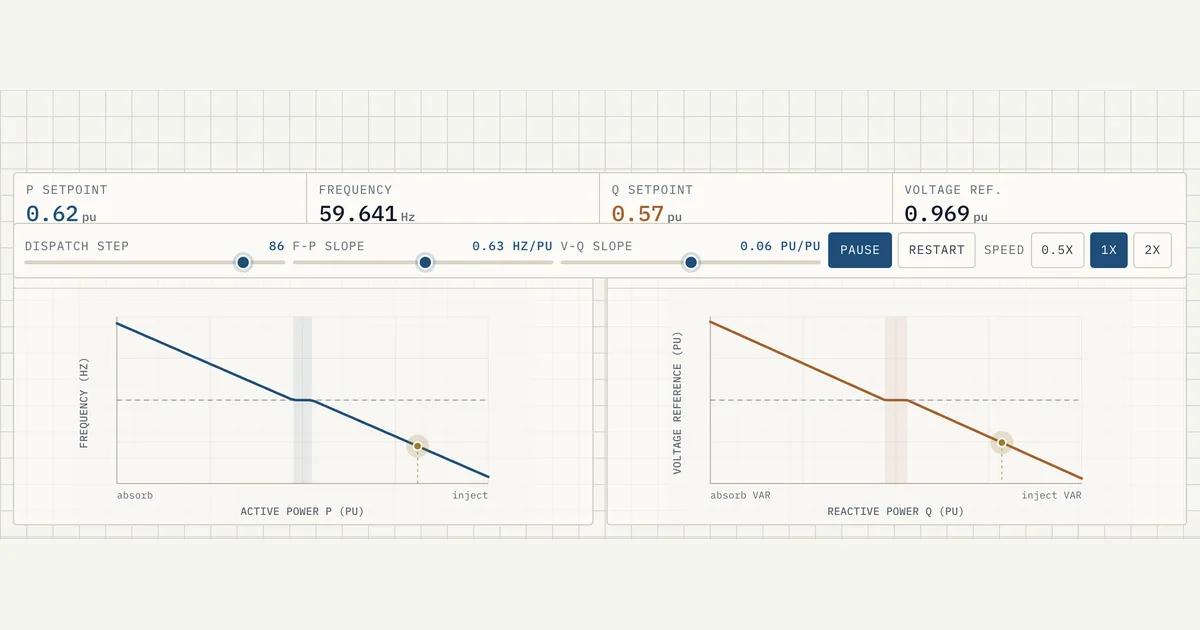 Interactive · bess.engineer ↗
 Key facts
| Nominal frequency | 50 Hz (Europe, GB, Australia) or 60 Hz (North America, ERCOT) |
|---|---|
| Typical droop | 2-5%; FERC Order 842 caps new US units at 5% |
| Droop-to-MW relation | ΔP / P_rated = (Δf / f_nom) / droop — 100 MW at 5% droop ≈ 3.3 MW per 0.1 Hz on a 60 Hz system |
| Deadband | ±10-15 mHz for fast products; ±36 mHz max under FERC 842 |
| Deadband cost | ±36 mHz at 5% droop on 60 Hz withholds ~1.2% of rating before the first MW moves |
| Full-activation deviation | FCR ±200 mHz; GB Dynamic Containment ±0.5 Hz |
| Equivalent droop of fast products | FCR ~0.4% (±10 mHz to ±200 mHz); GB Dynamic Containment ~1% (±15 mHz to ±0.5 Hz) — ERCOT FFR is a threshold step, no slope |
| Full-response time | ERCOT FFR ~0.25 s (15 cycles); GB DC ≤1 s; FCR ≤30 s (Continental Europe; GB 10 s) |
| Sustain duration | commonly ≥15 min for fast / limited-energy products |
| RoCoF withstand | 1-2 Hz/s in modern codes (higher in island grids) — often the binding trip limit |
| UFLS first stage | ~59.3 Hz on 60 Hz systems; ~48.8 Hz in GB |
| Governing market rules | GB Grid Code / SO service specs, ERCOT nodal protocols, AEMO NER (FCAS), ENTSO-E (FCR) |
| Capability standards | IEEE 2800-2022 (transmission IBRs); NERC BAL-003 (BA obligation, MW per 0.1 Hz) |
| Duty profile | power-intensive, short-energy — sizes C-rate and PCS headroom, not MWh |
| Safety standards (same system, separate role) | UL 9540 (ESS certification), UL 9540A (fire-propagation test data), NFPA 855 (installation) |
Typical values and standards
Droop is commonly quoted at 2 to 5 percent; FERC Order 842 caps new US units at 5 percent droop and ±36 mHz deadband. Fast products pair a small deadband with a defined activation band: continental FCR uses roughly a ±10 mHz deadband with full activation at ±200 mHz within 30 seconds; GB Dynamic Containment uses about ±15 mHz with full delivery at ±0.5 Hz within 1 second; ERCOT FFR requires full output within about 15 cycles (~0.25 s) once frequency crosses 59.85 Hz, sustained at least 15 minutes.
Three numbers define any product — deadband, activation band, and response time — and all are revised over time, so size against the current published terms.
Read those product numbers back as droop settings and the family sorts itself into order. Droop is the per-unit frequency change that commands a full-rated power change, so delivered power in per unit of rating is (Δf / f_nom) divided by the droop: a 100 MW plant at 5 percent droop on a 60 Hz system moves about 3.3 MW for a 0.1 Hz deviation, in the same MW-per-0.1-Hz unit NERC BAL-003 uses to state North American balancing-authority obligations.
Push the market products through the same relation and they are far steeper than any governor. FCR spans ±10 mHz to full output at ±200 mHz — 0.19 Hz on a 50 Hz base, an equivalent droop near 0.4 percent; GB Dynamic Containment's ±15 mHz to ±0.5 Hz span works out near 1 percent.
The deadband decides where that line starts, and it is not free: ±36 mHz on a 60 Hz system at 5 percent droop withholds about 1.2 percent of rating before the first megawatt moves — sensible on a governor meant to ignore everyday noise, disqualifying on a containment product meant to catch the event.
Two bases must travel with any droop figure, the nominal frequency and the rated power it refers to, because a slope set on aggregate inverter rating and one set on the contracted export limit give different MW for the same dip. ERCOT FFR sits outside this comparison: it arms at a frequency threshold and steps to full output, so it has no slope to quote.
Performance is governed by grid codes and market rules, not one global standard: the GB Grid Code and system-operator service specs, ERCOT nodal protocols, AEMO's NER and FCAS rules, and ENTSO-E network codes. Alongside them, IEEE 2800-2022 defines frequency-response and ride-through requirements for transmission-connected inverter-based resources, and NERC BAL-003 sets each balancing authority's obligation in MW per 0.1 Hz.
Under-frequency load shedding typically starts near 59.3 Hz on 60 Hz systems and 48.8 Hz in GB — fast response exists to keep events clear of those trips. These operational rules are separate from safety standards on the same system: UL 9540 certifies the ESS product, UL 9540A generates fire-propagation test data, and NFPA 855 governs installation.
How it shows up in specs, studies and contracts
On a PCS datasheet the function is the frequency-watt or P(f) line. Check the configurable deadband and droop ranges, and check where the droop line is anchored: a line originating at the deadband edge leaves zero power there, while one extrapolated from nominal frequency jumps to a finite step the instant the deadband is crossed, and the two deliver visibly different MW near the edge, so firmware and interconnection study have to agree on which is running.
Check the combined measurement-plus-response latency, and — the question most buyers forget to ask the vendor — whether the P(f) curve executes locally in the PCS or is commanded from the plant controller: routing the loop through the PPC adds hundreds of milliseconds and can disqualify a plant from any sub-second product.
Confirm the measurement point, because delivery at the point of interconnection is net of transformer and auxiliary losses, so terminal-rated MW is not deliverable MW. Verify P-Q capability at the contracted power factor, since four-quadrant operation runs the reactive duty simultaneously.
In interconnection studies the service appears both as mandatory capability (FERC Order 842, governor clauses in most grid codes) and as frequency ride-through envelopes with RoCoF-withstand values, commonly 1 to 2 Hz per second and higher in island systems — that withstand figure is often the binding constraint, since an asset that trips delivers nothing.
Market prequalification runs injection tests against reference frequency traces with sub-second telemetry and baselining rules that decide whether you are paid. In contracts, scrutinise availability definitions, SoC-management responsibility, and penalty regimes; in the battery supply agreement, confirm the warranty counts shallow FR micro-cycles as fractional throughput rather than charging a full equivalent cycle per excursion.
Common pitfalls
Two conflations cause most of the confusion. First, frequency response is not frequency regulation: FFR and primary response are autonomous, local, droop-driven reactions to frequency error acting within seconds, while regulation (AGC or aFRR) is a centrally dispatched setpoint-following service over minutes — a plant can be excellent at one and unqualified for the other.
Second, response is not ride-through: ride-through is the obligation to stay connected through a disturbance, a precondition rather than the service itself. A battery that trips on a 1 Hz-per-second RoCoF event delivers no response at all, however fast its controls, which is why the withstand number gates qualification before the P(f) curve ever matters.
The energy dimension is routinely under-scoped. A 15-minute sustain at full power needs only 0.25 hours of energy on paper, but symmetric products demand headroom in both directions, SoC recovery must finish inside the service window, and the usable SoC band shrinks the tradable range further.
EV traction batteries face a completely different duty and are a poor mental model for this shallow, high-frequency cycling. Do not design from yesterday's parameters: deadbands, droop slopes, activation bands and sustain times differ product by product and change regularly, so qualification is always against the current published service terms, not a textbook table you memorised last year.
Sources & standards
Common misconception
A battery can provide frequency response as long as its PCS meets the power rating — the energy requirement is trivial, since a 15-minute product is only 0.25 hours.
In reality: The binding constraint is rarely peak power or energy; it is managed SoC headroom and response time. A symmetric product must hold mid-range state of charge to deliver both discharge and charge on demand, hit strict per-product response-time and sustain limits, and pass availability and telemetry tests at the point of interconnection net of losses. An asset that comfortably meets its MW rating but drifts to full or empty SoC, or answers 200 ms too slow, forfeits payment for the interval regardless of nameplate.
Visuals & further reading
- P-f droop — the control law itself Glossary
- Frequency regulation Glossary
- Ride-through Glossary
- Frequency Glossary
- Interactive: ERCOT FFR Dispatch Timeline Interactive visual · bess.engineer
- Interactive: Grid Inertia and RoCoF Interactive visual · bess.engineer
- Interactive: Grid-Forming Droop Interactive visual · bess.engineer
- How Frequency Regulation Pays Batteries — and Why That Paycheck Shrinks Article
- Grid-Forming BESS, Explained: Inertia, System Strength, and Why Every Grid Operator Suddenly Cares Article
Frequency response, in context.
How a Battery Gets Paid covers frequency response — and the rest of the revenue stack — from the ground up, the way it actually gets deployed.