Clipping / curtailment
Reviewed October 2026 by Sergey Syrvachev
Clipping and curtailment both describe power or energy a battery plant could have delivered but did not, because output was capped. Clipping is an internal hardware limit: available DC power exceeds what the power conversion system, transformer, or point of interconnection can pass, so the inverter holds output at its AC ceiling.
Curtailment comes from outside, and it arrives two ways: usually as a price signal, and more rarely as an explicit instruction to reduce output. The distinction matters because clipping costs instantaneous megawatts while curtailment costs dispatch opportunity — and in a standalone BESS the energy usually stays in the cells either way, unlike solar, where clipped DC is lost forever. You meet both on a datasheet, an interconnection study, and an offtake contract.
New to BESS? Start free in the Learn BESS hub — no cost, no account.
What it is (precise)
Clipping occurs inside the asset, at whichever link in the power path binds first. A grid-scale BESS is DC battery racks feeding bidirectional PCS blocks, typically around 1–5 MVA each, through a medium-voltage transformer to the point of interconnection.
The effective ceiling is the minimum of the PCS AC rating (an apparent-power figure, derated for ambient temperature and altitude), the transformer nameplate, and the contracted POI limit. Reference points matter: DC capability, AC terminal output, and net POI power are three different numbers, separated by conversion, transformer, and auxiliary losses. Whichever is smallest is what actually clips you.
Because the PCS is sized in apparent power (MVA) and S² = P² + Q², reactive-power obligations eat directly into real-power headroom. A grid code that demands operation down to 0.95 power factor while injecting reactive support means the plant cannot simultaneously deliver its full MW; the P-Q capability curve and four-quadrant operation define exactly how much active power gets clipped when Q is dispatched.
Thermal derating compounds this — many utility PCS designs hold full rating to roughly 40–50 °C ambient and then fold back, so a hot afternoon can clip output the datasheet's headline number promised at 25 °C.
Curtailment comes from outside. An ISO/RTO market, transmission operator, or grid-code function commands the plant below capability — for congestion, oversupply, or system security — usually as a setpoint over the SCADA and plant-controller path.
Two BESS-specific twists: curtailment cuts both directions, so a plant can be blocked from charging during negative-price oversupply just as it can be blocked from discharging; and a grid-following plant tracking an external setpoint must honor defined ramp rates and response times when the signal arrives, which is where curtailment overlaps operational frequency response.
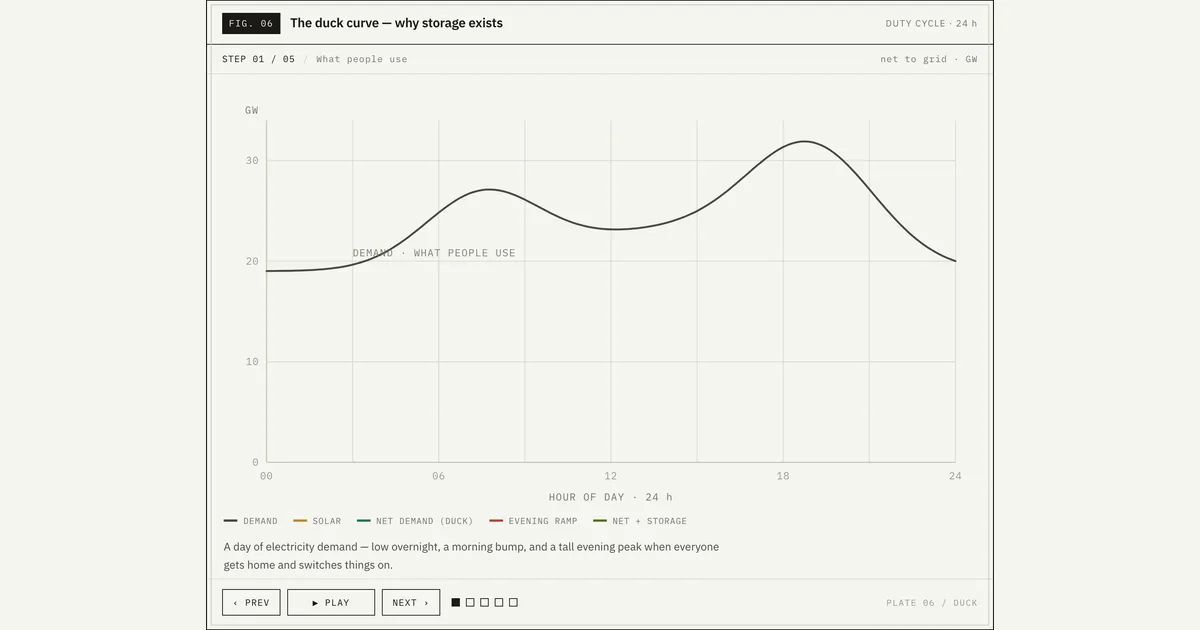 Interactive · bess.engineer ↗
 Numbers
Key facts
| Clipping cause | Available DC power exceeds the min of PCS AC rating, transformer nameplate, or POI limit — size AC to peak dispatch MW, not to MWh |
|---|---|
| Curtailment cause | External operator/market/grid-code setpoint cuts output OR charging — model an expected annual % and confirm whether it is compensated |
| Continuous C-rate | ~0.25C (4-h) to 0.5C (2-h) typical utility LFP; ~1C where ancillary services dominate — higher C-rate avoids clipping but costs more per kWh |
| PCS block size | Typically ~1–5 MVA per block, rated in apparent power (MVA) not MW — reactive dispatch subtracts from real-power headroom |
| Thermal derating onset | Full PCS rating typically to ~40–50 °C ambient and ~1,000 m altitude, fold-back beyond — read output at site design temperature, not 25 °C |
| Reactive-power clipping | S² = P² + Q²: a 0.95 PF obligation trims available P by roughly 5% of S when Q is fully dispatched |
| Hybrid clipping recapture | DC-coupled solar+storage at ~1.2–1.4 inverter load ratio stores energy AC clipping would waste — recapture is designed-in, not a defect |
| Curtailment factor | Renewables in congested regions: typically <2% up to ~5–10%/yr; BESS usually lower and partly recoverable — model a range, stress the high case |
| Terminal vs POI gap | Aux loads + transformer losses typically shave a few percent between inverter terminals and net POI — spec and bid at POI, not terminals |
| Governing rules | ISO/RTO tariffs + FERC interconnection agreements + IEEE 2800 (transmission); IEEE 1547 (distribution) |
| Not the governing rules | UL 9540 (ESS safety cert), UL 9540A (fire-propagation test), NFPA 855 (installation) — hazard domain, no bearing on clipping/curtailment |
| Recoverability | Clipped/curtailed BESS energy usually stays in the cells; instantaneous MW and the market window are what is lost — recoverable is not recovered |
Typical values and standards
The ratio that governs clipping is AC power divided by usable DC energy — the continuous C-rate at the inverter. Utility LFP projects commonly land between 0.25C (4-hour) and 0.5C (2-hour), with 1C systems appearing where ancillary services dominate; LFP dominates stationary builds for cost, cycle life, and thermal margin, with NMC mainly where power density is prioritized. On the derating side, expect full PCS rating typically up to about 40–50 °C and up to roughly 1,000 m altitude, with linear fold-back beyond — power is a matrix of voltage, temperature, and altitude, never a single number.
Curtailment is quantified as a curtailment factor: the fraction of available energy or power not delivered on instruction. Renewable curtailment in congested, renewable-heavy regions has typically run from under 2% to around 5–10% of annual generation depending on year and network; standalone BESS curtailment is usually lower and often recoverable by shifting dispatch, but any single-project figure is site-specific — model a range, not a point, and stress-test the high case in the revenue model.
The governing documents are interconnection and grid-code instruments, not safety standards. For US transmission-connected plants that means the ISO/RTO tariff, the FERC-jurisdictional interconnection agreement, and IEEE 2800 for inverter-based-resource performance; at distribution level, IEEE 1547 sets the interconnection and curtailment-response requirements.
These are distinct from UL 9540 (the ESS safety certification), UL 9540A (the fire-propagation test method), and NFPA 855 (the installation standard), which govern hazard and siting and have no bearing on clipping or curtailment. Keep the two domains separate when writing or reviewing specifications.
In practice
Why it matters in a real grid-scale project
Both effects hit the revenue stack and the financial model. An AC-undersized plant chronically clips power during high-rate dispatch, capping the megawatts it can bid into energy and ancillary markets even when megawatt-hours sit in the cells.
This is a deliberate sizing trade: a 4-hour system running at 0.25C is cheaper per kWh but power-limited, while a 1–2-hour system at 0.5C–1C avoids clipping at higher PCS and balance-of-plant cost per kWh. Clipping also erodes frequency response headroom — a plant already at its AC ceiling has nothing left to offer for fast reserves, so the sizing choice quietly decides which markets you can even enter.
Curtailment risk drives interconnection strategy and bankability. Whether curtailment is compensated (firm capacity, or a market that pays for held energy) or uncompensated changes what a lender will underwrite; an expected annual curtailment percentage must be modeled into throughput and revenue, and it flows straight into the coverage ratios lenders test.
In DC-coupled solar-plus-storage hybrids the logic inverts profitably: solar arrays built at inverter load ratios of roughly 1.2–1.4 would clip on the AC side, but a DC-coupled battery captures that otherwise-lost energy — here clipping recapture is a designed-in revenue stream, not a defect.
How it shows up in specs, studies and contracts
On PCS and integrated-system datasheets, find the kVA and kW ratings and the conditions bolted to them: reference temperature, altitude, power factor, and AC voltage. Ask for the full derating curves, not the headline. The single line that traps buyers is whether the stated MW is at the inverter terminals or net at the POI — auxiliary loads (HVAC, controls) and transformer losses typically shave a few percent between the two, so a contract written at POI against a datasheet written at terminals is a built-in clipping surprise before the plant even energizes.
In interconnection studies, the POI limit appears twice: maximum injection and maximum withdrawal. A BESS that cleared injection headroom can still face charging curtailment if the withdrawal side was never studied, which quietly cuts the energy available to sell later.
Verify the deliverability status (firm versus as-available in US practice), the modeled congestion hours, and the required volt-var and power-factor envelope — the Q obligations decided here are what later clip P through the apparent-power budget. Read the study's reactive requirement together with the datasheet's P-Q capability curve, not in isolation.
In offtake and tolling agreements, look for how curtailment interacts with availability guarantees: who bears uncompensated curtailment, whether operator-instructed hours are carved out of availability calculations, and how capacity tests treat a clipped plant. Three questions settle most reviews: what is the plant's net POI MW at the site's design ambient temperature and worst-case power factor; what annual curtailment percentage is in the revenue model; and is that curtailment compensated? If any answer is missing, the clipping or curtailment risk is un-priced.
Pitfalls
Common pitfalls
The classic error is importing solar intuition: treating BESS clipping as lost energy. In a standalone battery, clipped and curtailed energy usually remains in the cells — what is lost is instantaneous MW capability and the market opportunity attached to that interval. The recoverability is real but not free: if the price spread that justified the dispatch closes before the plant can shift it, the arbitrage value is gone even though the megawatt-hours are not. Recoverable is not the same as recovered.
Watch for double-counting and hidden headroom losses. Bidding DC or terminal ratings into a market that settles at the POI overstates capability by the loss chain; ignoring reactive dispatch understates clipping on hot days when derating and Q obligations stack; and assuming curtailment only affects discharge misses the charge-side restrictions that determine whether the plant is even full when the valuable hours arrive. Each of these is a number a careful reviewer can catch on the datasheet, the study, or the contract before it becomes a shortfall.
Common misconception
Clipping in a battery plant permanently destroys stored energy, the same way a solar plant loses clipped DC.
In reality: In a standalone BESS the clipped quantity is instantaneous power, not energy — the surplus simply remains in the cells and can be dispatched later. What you actually lose is megawatt capability (C-rate, fast-response headroom) at that moment, plus any market opportunity tied to it. Solar clips irretrievable energy; a BESS mostly clips power — and only forfeits the energy value if the price spread closes before you can shift the dispatch.
Go further
Visuals & further reading
- Curtailment mitigation — storing what would otherwise be spilled Glossary
- Interactive: The Duck Curve Interactive visual · bess.engineer
- Interactive: Revenue Stacking Example Interactive visual · bess.engineer
- Interactive: PCS Dispatch Efficiency Interactive visual · bess.engineer
Clipping / curtailment, in context.
The Grid-Scale BESS course covers clipping / curtailment — and the rest of the system — from the ground up, the way it actually gets deployed.