Cathode
Battery Essential term
Reviewed October 2026 by Sergey Syrvachev
The cathode is the positive electrode of a lithium-ion cell: a lithium-bearing metal-oxide or phosphate active material coated onto aluminum foil, facing the anode across the separator. It is the electrode whose chemistry names the whole battery — LFP (lithium iron phosphate, nominal ~3.2 V per cell) or NMC (nickel manganese cobalt oxide, ~3.6-3.7 V) — and it largely sets the cell's energy density, raw-material cost, cycle life, and thermal-runaway behavior.
For grid-scale stationary storage the cathode is the single most consequential design choice inside the cell, and its effects propagate outward to container layout, fire protection, warranty structure, and project economics.
New to BESS? Start free in the Learn BESS hub — no cost, no account.
What the cathode actually is
During discharge, lithium ions leave the anode (typically graphite), cross the separator through the electrolyte, and intercalate into the cathode's crystal lattice, while electrons flow through the external circuit to the load — through the PCS and out to the point of interconnection. On charge the process reverses. The cathode is therefore the lithium reservoir of the cell: its lattice capacity and its voltage against graphite define how much charge the cell stores and at what potential it delivers it.
Physically, the cathode is a composite coating: micrometer-scale active-material particles mixed with a polymer binder and conductive carbon, calendered onto an aluminum current collector foil typically 12-20 micrometers thick (around 15 micrometers common), coated on both sides.
Coating thickness and areal loading are the manufacturer's main levers for trading energy against power — stationary cells use thick, heavily loaded cathodes because a 2-4 hour system only needs 0.25-0.5C, far below what an EV demands. Strictly, "cathode" means the reduction electrode and only applies to the positive electrode during discharge, but industry convention fixes the name to the positive electrode permanently.
The cathode material is the naming convention for the whole battery. In today's stationary fleet that material is overwhelmingly LFP (LiFePO4), an olivine-structured phosphate; the exact chemistry is covered under lithium iron phosphate.
NMC, a layered nickel-rich oxide, is the main contrast chemistry and still appears in some installed assets, but LFP now dominates new grid-scale procurement on cost, cycle life, and safety. Sodium-ion cells — with layered-oxide or Prussian-blue-family cathodes — are the emerging third option for stationary duty, trading lower energy density for cheaper, lithium-free raw materials.
Why it matters in a real grid-scale project
The cathode choice drives the entire safety case and, with it, the cost of the balance of plant. LFP's phosphate bonds hold their oxygen: the olivine lattice does not release oxygen appreciably during thermal runaway, whereas layered nickel-oxide cathodes liberate lattice oxygen at elevated temperature, which feeds the exothermic reaction internally.
An LFP cell therefore vents later, with lower peak heat-release rate and less violent off-gassing than NMC. That difference shows up directly in the UL 9540A cell, unit, and installation-level test results that AHJs and insurers rely on, and it eases the separation distances and explosion-protection demands NFPA 855 imposes.
Commercially, the cathode is the dominant cost lever: the cathode active material is typically the largest single cost component of a cell, on the order of 30-40% of cell cost. LFP uses iron and phosphate instead of cobalt and high nickel loadings, insulating projects from cobalt price and supply-chain risk — a real consideration for multi-hundred-MWh procurements financed over 15-20 years. The trade-off is lower volumetric energy density, so an LFP project needs modestly more container footprint per MWh than an equivalent NMC design, which the site layout and civil scope must absorb.
The cathode also shapes controls. LFP's discharge curve is famously flat — cell voltage barely moves across most of the usable window — so the BMS cannot infer state of charge from voltage alone in the mid-range and must lean on coulomb counting with periodic recalibration at the voltage "knees." That is a cathode property, not a BMS defect, and it explains why LFP fleets see occasional SOC-estimate jumps after a full charge. Cathode degradation — particle cracking, loss of active lithium inventory — is likewise the main driver of the state of health fade that capacity warranties track.
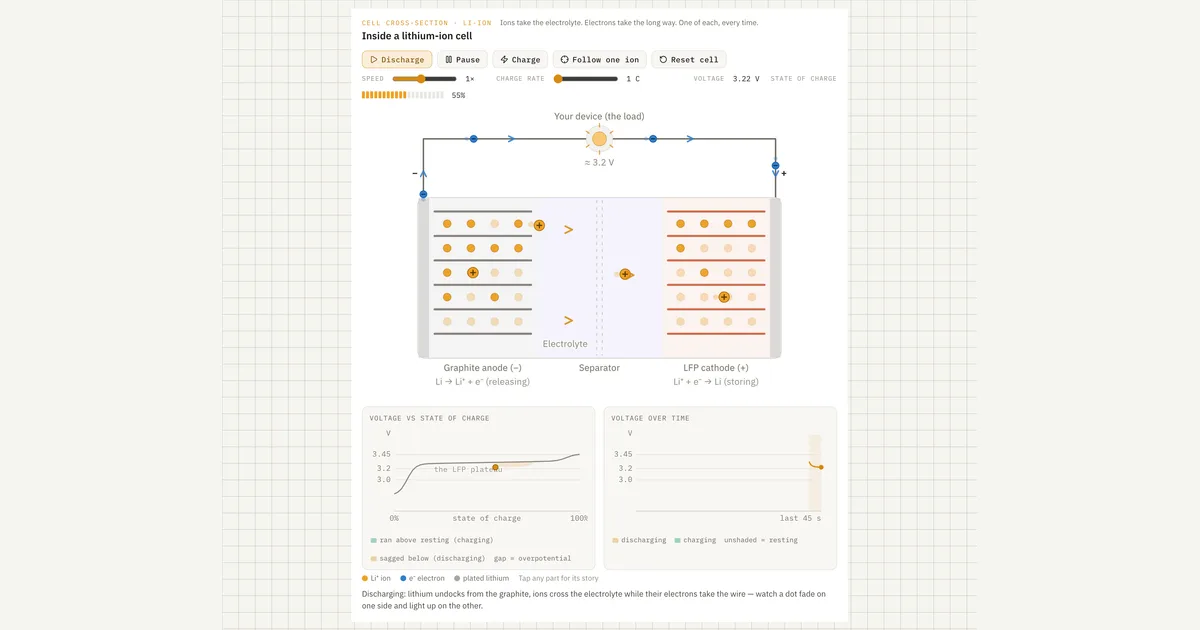 Interactive · bess.engineer ↗
 Key facts
| Position in the cell | Positive electrode, coated on aluminum foil (~12-20 um, typically ~15 um) |
|---|---|
| Dominant stationary cathode | LFP (LiFePO4), olivine phosphate |
| Contrast chemistry | NMC (LiNiMnCoO2), layered oxide |
| LFP cell voltage | ~3.2 V nominal (window ~2.5-3.65 V) |
| NMC cell voltage | ~3.6-3.7 V nominal (charge limit ~4.2-4.3 V) |
| LFP cell specific energy | ~160-190 Wh/kg (cell level) |
| NMC cell specific energy | ~200-280 Wh/kg (cell level) |
| LFP cycle life (typical warranty basis) | ~6,000-10,000 cycles to ~80% capacity at reference conditions |
| Cathode share of cell cost | Typically ~30-40% — largest single component |
| Common stationary cell formats | 280 Ah / 314 Ah prismatic LFP (~0.9-1.0 kWh/cell) |
| Oxygen release in runaway | NMC oxides liberate lattice oxygen; LFP olivine does not appreciably |
| Standards stack | IEC 62619 (cells and batteries) / UL 1973 (cell to rack) / UL 9540 (system cert) / UL 9540A (fire test) / NFPA 855 (installation) |
Typical values and standards
Orientation numbers: LFP cells run a nominal ~3.2 V with an operating window of roughly 2.5-3.65 V; NMC runs ~3.6-3.7 V nominal with charge limits typically near 4.2-4.3 V. Cell-level specific energy is typically ~160-190 Wh/kg for modern stationary LFP versus roughly 200-280 Wh/kg for NMC — cell-level figures only, since pack and container numbers land far lower after racking, enclosures, and HVAC. Utility-scale procurement today centers on large prismatic LFP formats, typified by 280 Ah and 314 Ah cells at around 0.9-1.0 kWh each, assembled into modules and racks.
Cycle life is where LFP cathodes justify stationary duty: vendors typically warrant on the order of 6,000-10,000 full cycles to ~80% remaining capacity at reference temperature and depth of discharge, versus a few thousand for NMC — underpinning the 15-20 year, roughly daily-cycle warranties common in stationary contracts. Treat every such figure as conditional: what counts as one cycle, the reference temperature, C-rate, and depth of discharge are all defined in the warranty, and cycle life quoted at 25 C and 0.5C does not transfer to a hotter site or harder duty.
The standards stack layers by role. IEC 62619 covers safety of lithium cells and batteries for industrial applications; UL 1973 covers the stationary battery from cell to pack and rack; UL 9540 is the safety certification of the complete ESS product; UL 9540A is the fire and thermal-runaway propagation test method whose data feeds NFPA 855, the installation standard, with NFPA 68/69 covering deflagration venting and prevention for the flammable off-gas the cathode helps produce during runaway.
The cathode chemistry is the input that determines how demanding compliance with all of these becomes.
How it shows up in specs, studies and contracts
On a cell or DC-block datasheet, the cathode appears as the "chemistry" line and then hides inside every number that follows. Check that the chemistry is stated explicitly (LFP, NMC, sodium-ion — not just "lithium-ion"), that nominal energy is distinguished from usable energy, and that BOL and EOL values are both given.
Cycle-life claims should come as curves with stated temperature, C-rate, and DOD, not a single count. For safety submittals, ask for the UL 9540A test report at cell, module, and unit level for the actual cathode chemistry and cell model being supplied — results do not transfer between chemistries or even between cell formats.
In contracts, the cathode lives inside the capacity guarantee and degradation table: the guaranteed MWh-versus-year schedule is a promise about cathode fade, and augmentation plans, liquidated damages, and end-of-term buyouts all price off it.
Questions worth asking: is the degradation curve backed by test data on this exact cell, or extrapolated from an accelerated protocol; what cycling and temperature assumptions void the warranty; and is the supplier free to substitute a different cell (and cathode) mid-delivery? A chemistry substitution can silently change the fire-protection design basis, footprint, and the insurer's view of the asset.
Common pitfalls
Do not compare chemistries on mismatched numbers. Cell-level Wh/kg says little about installed footprint — compare MWh per container or per acre instead — and LFP-versus-NMC cycle-life comparisons are meaningless unless temperature, DOD, and end-of-life definition match.
Equally, do not read the cathode as the whole safety story: cell format, module design, electrolyte volume, and container-level detection and venting all shape the UL 9540A outcome, which is why an LFP system with poor integration can test worse than expected, and why the certification (UL 9540) and the test method (UL 9540A) must never be conflated.
Common misconception
LFP is a "safe" cathode chemistry that cannot catch fire or go into thermal runaway.
In reality: LFP is more thermally tolerant than NMC — it vents later, with lower peak heat release, and its phosphate lattice does not liberate oxygen the way layered oxides do — but LFP cells still undergo thermal runaway and still produce large volumes of flammable off-gas (hydrogen, CO, hydrocarbons). That is precisely why LFP installations must still pass UL 9540A testing and comply with NFPA 855 and NFPA 68/69. The cathode lowers the severity and probability; it does not remove the hazard.
Visuals & further reading
- Interactive: Lithium-Ion Cell Interactive visual · bess.engineer
- Sodium-Ion vs LFP for Grid Storage — and Where NMC Still Fits Article
- BESS Fire Safety in 2026: Thermal Runaway, NFPA 855, and UL 9540A Article
Cathode, in context.
The Grid-Scale BESS course covers cathode — and the rest of the system — from the ground up, the way it actually gets deployed.