Revenue stacking
Markets Essential term
Reviewed October 2026 by Sergey Syrvachev
Revenue stacking — also called value stacking — is the practice of earning income from multiple grid services with a single utility-scale battery energy storage system — combining wholesale energy arbitrage, frequency response and other ancillary services, and capacity-market payments — rather than dedicating the asset to one product.
Because a stationary battery's power (MW) and energy (MWh) are time-shareable, the same racks and power conversion system can be reallocated across services hour by hour to raise total lifetime revenue and shorten payback. It is fundamentally a co-optimization and dispatch problem: deciding, interval by interval, which service each MW and MWh should serve while respecting physical and contractual limits at the point of interconnection (POI).
Back to the free route: The money — no cost, no account.
What revenue stacking actually stacks
A grid-scale BESS has a finite power rating, set by the PCS and transformer at the POI, and a finite usable energy budget, set by cell capacity, the state-of-charge window, and degradation guardrails.
Revenue stacking partitions those two resources across services that pay on different bases: energy arbitrage pays on the price spread between charge and discharge; regulation and reserves pay for capacity held available, plus a mileage or throughput component in some markets; and capacity market or resource-adequacy programs pay for being dispatchable at system peak. Stacking can be simultaneous — holding regulation headroom while doing light arbitrage — or sequential, such as regulation overnight and energy discharge into the evening peak.
Services are not free to combine, because they share the same MW and MWh. Reserving 10 MW for contingency reserve removes 10 MW from the arbitrage envelope, and a regulation award constrains how far state of charge may drift. Co-optimization software solves for the allocation that maximizes total expected value subject to these shared constraints; in most US markets the ISO / RTO itself co-clears energy and ancillary products in one optimization, so the owner's bid strategy, not manual switching, is what implements the stack.
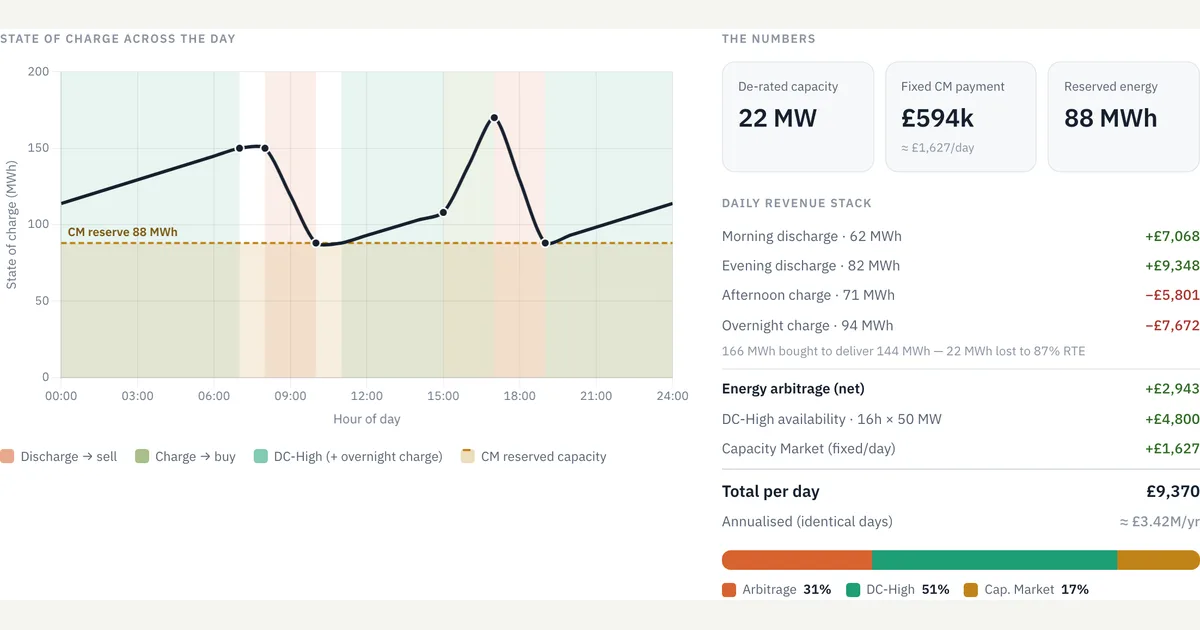 Interactive · bess.engineer ↗
 Revenue stacking vs value stacking
The two names describe the same practice. Revenue stacking is the operator and trading usage — income streams a dispatch schedule actually books, service by service. Value stacking appears more often in policy and investor material, where the stack is framed as the value the asset creates rather than the invoices it raises. Nothing in the practice changes with the label.
The one distinction worth keeping is between a stack and a portfolio: stacking means one asset earning across several services within the same operating window, with the conflicts that creates — the theme of the rest of this entry. Reading a strategy deck, treat the two phrases as interchangeable and check what is actually in the stack instead.
Numbers
Key facts
| Typical duration | 2-4 hours (drives which services can stack; trending longer) |
|---|---|
| AC round-trip efficiency | ~85-90% incl. PCS, transformer, aux loads |
| Arbitrage break-even spread | Discharge price ≳ charge price × 1/RTE (~1.12-1.18×) plus cycling cost |
| Typical stacked cycling | ~250-400 equivalent full cycles/year on merchant assets |
| Typical warranty duty | ~1 cycle/day (≈365/yr) or annual MWh throughput cap |
| Regulation market depth | A few hundred MW to ~1 GW per ISO (~1% of peak load) — saturates fast |
| Response obligations | Regulation: seconds; contingency reserves: typically 10-30 min deployment |
| Capacity accreditation | 4-h storage near full credit at low penetration; ELCC declines as storage grows |
| Dominant chemistry | LFP for stationary BESS; NMC as higher-energy-density contrast |
| Safety standards | UL 9540 (system certification), UL 9540A (fire propagation test data), NFPA 855 (installation) |
| Core constraint | Shared MW (PCS/POI) and MWh (usable energy) across all services |
Typical values and standards
Duration decides what can stack. Most utility-scale projects today are 2-4 hour systems: shorter-duration assets favor power-dense products like frequency response, longer-duration assets capture more arbitrage and capacity value. AC round-trip efficiency of roughly 85-90%, including PCS, transformer, and auxiliary loads, sets the arbitrage break-even: at ~88% RTE the discharge price must exceed the charge price by about 14% before degradation cost is even counted.
Stacked merchant assets commonly run around 250-400 equivalent full cycles per year, while warranties are typically written around one cycle per day or an annual throughput cap — the gap between those two numbers is a real contractual constraint.
Ancillary markets are structurally shallow. Regulation requirements in a typical ISO / RTO are only a few hundred MW to roughly 1 GW — on the order of 1% of peak load — so a few GW of installed batteries can saturate them. ERCOT demonstrated this through 2023-2025: as the fleet grew past several GW, ancillary prices compressed and the fleet's revenue mix shifted from ancillary-dominated toward energy arbitrage.
Capacity accreditation follows a similar curve: a 4-hour battery typically earns near-full capacity credit at low storage penetration, with effective load carrying capability declining as penetration rises. Response obligations differ by product — regulation follows a signal within seconds, contingency reserves typically deploy within 10-30 minutes.
Market rules, not the battery, often cap the stack: each ISO / RTO defines which products may co-clear, state-of-charge telemetry and management obligations, and minimum response speeds.
Physical and code constraints are independent of the revenue model and always apply — UL 9540 certification for the energy storage system, UL 9540A test data on fire and thermal-runaway propagation feeding the NFPA 855 installation requirements, and NFPA 68/69 for deflagration venting and explosion prevention. No revenue stack justifies operating outside the manufacturer's voltage, temperature, or C-rate limits or the warranty envelope.
In practice
Why it matters in a real grid-scale project
Single-service business cases rarely clear the hurdle rate for project finance. Ancillary services markets are shallow and saturate quickly once batteries enter, compressing prices, while arbitrage spreads alone are volatile and weather-dependent.
Stacking diversifies revenue so a downturn in one product is partly offset by others — diversification that lenders translate into lower revenue risk, a healthier debt service coverage ratio, and larger sustainable debt. Whether the stack is sold merchant or wrapped in a toll is exactly the merchant vs. contracted decision, and it drives the capital structure as much as the technology does.
Stacking also reshapes engineering requirements. Heavy cycling for arbitrage accelerates capacity fade, so warranty terms — cycles per year, annual MWh throughput, average C-rate, resting state of charge — must match the intended duty. Frequency-response duty imposes fast power transients on the PCS and thermal system.
The augmentation plan, the LFP cell choice favored in stationary BESS for cycle life and thermal stability over higher-energy NMC, and the cooling design all flow from the assumed stack. A mismatch between the financed revenue stack and the physical design is a common root of underperformance disputes.
How it shows up in specs, studies and contracts
A working engineer meets the stack first in the duty-cycle assumptions. The battery supply agreement and warranty encode it as cycles per year, annual energy throughput, allowable average and peak C-rate, and an augmentation or capacity-maintenance schedule.
The interconnection study fixes the POI limits — injection and withdrawal MW, and whether charging is treated as load with its own study and charges. The revenue model in the financial close package assumes a specific service mix; check that its cycle count and depth-of-discharge profile actually fit inside the warranty and the augmentation plan, because that reconciliation is where stacks quietly break.
On the commercial side, tolling and offtake agreements may restrict stacking outright — a capacity or resource-adequacy contract usually imposes must-offer availability windows that pre-empt arbitrage during those hours, and some tolls hand full dispatch rights to the offtaker.
In the US, the standalone-storage investment tax credit removed the old renewable-charging coupling, which widened grid-charging arbitrage strategies for new projects, though tax rules evolve and need current confirmation. Questions to ask on any project: which products can legally co-clear in this market, who manages state of charge and bears failure-to-perform penalties, and what happens to the stack when the ancillary market saturates.
Pitfalls
Common pitfalls
The classic modeling error is pricing the stack at today's ancillary clearing prices for a 20-year horizon. Because regulation and reserve demand are nearly fixed while battery supply grows, those prices fall fast — projects financed on saturated-market assumptions in ERCOT and Great Britain saw ancillary revenue shares collapse within two to three years of entry. A defensible model shows the stack migrating toward energy arbitrage and capacity market value over time, with sensitivity cases, not a flat extrapolation of the current price strip.
Operationally, the trap is state-of-charge conflict. A regulation award consumes energy stochastically, so a battery that also committed its full MWh to the evening discharge can arrive at the peak partially empty, triggering imbalance charges or non-performance penalties. Co-optimizers hold SOC buffers precisely for this, which is another reason realized stacked revenue sits well below the naive sum of each product's standalone maximum.
Common misconception
Stacking means the battery simply earns from every service at once, so revenues add up to the sum of each market's full standalone value.
In reality: Services compete for the same MW and MWh. Capacity committed to one product is unavailable to another, so realized stacked revenue is the co-optimized allocation across shared limits — typically well below the naive sum of standalone maxima, and bounded by interconnection, state-of-charge, and warranty constraints.
Go further
Visuals & further reading
- How Grid Batteries Make Money: BESS Revenue Streams Article
- Interactive: Revenue Stacking Example Interactive visual · bess.engineer
- Interactive: The Duck Curve Interactive visual · bess.engineer
Revenue stacking, in context.
How a Battery Gets Paid covers revenue stacking — and the rest of the revenue stack — from the ground up, the way it actually gets deployed.