Energy arbitrage
Markets Essential term
Reviewed October 2026 by Sergey Syrvachev
Energy arbitrage is the practice of charging a grid-scale battery when wholesale electricity is cheap and discharging it when prices are high, capturing the spread as revenue. For a stationary BESS it is a time-shifting strategy: the asset buys energy at the point of interconnection (POI) during low-price hours, typically midday solar oversupply or overnight, and sells it back during the evening peak.
In US ISO/RTO markets, settlement is in MWh at the locational marginal price (LMP) of the battery's node; other markets settle zonally or at a system price. Arbitrage is the most fundamental value stream for utility-scale storage, though rarely the only one a project relies on.
Every variant of it is temporal arbitrage — the same stored MWh moved through time — and in Europe's coupled markets the position can be placed and re-placed across the day-ahead auction, the intraday market and, as a priced backstop, imbalance settlement.
Back to the free route: The money — no cost, no account.
What it is (precise)
Arbitrage exploits the temporal variation of the locational marginal price at the battery's grid node. A grid-connected BESS schedules a charge cycle when the nodal LMP is low, typically overnight or during midday solar oversupply, and a discharge cycle when the LMP peaks, usually across the early-evening net-load ramp — the steep evening upswing of the duck curve, as solar output fades while demand holds.
The trade can be placed in the day-ahead market, the real-time market, or split between both. Gross margin per cycle equals the price spread multiplied by the energy delivered at the POI, minus the cost of the energy lost to round-trip inefficiency and auxiliary consumption, with those losses valued at the charging price.
Arbitrage is a real-energy (MWh) play settled in the energy market, distinct from a capacity market payment or ancillary services such as frequency regulation. Most operating projects co-optimize arbitrage against these other streams, letting the ISO / RTO market engine and the plant optimizer dispatch to whichever opportunity pays best in each interval; that combined dispatch is revenue stacking.
A 4-hour system, for example 100 MW / 400 MWh running at 0.25C, is the canonical arbitrage configuration because it spans a typical daily peak window, though 2-hour and longer-duration systems are built depending on the market's price shape.
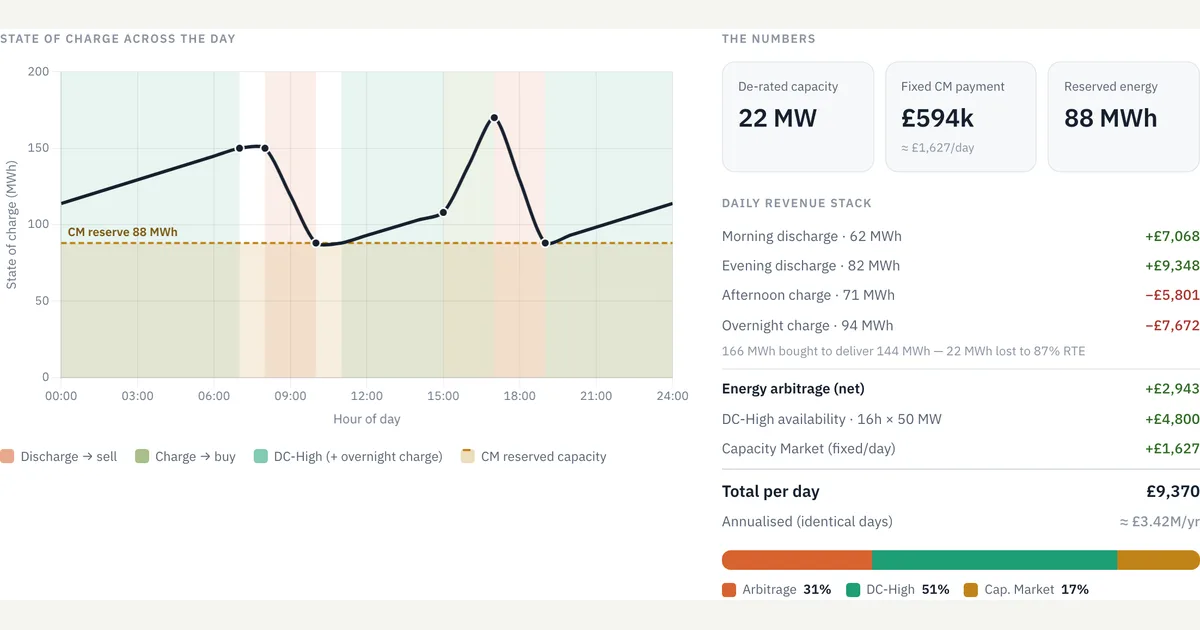 Interactive · bess.engineer ↗
 Temporal, product and geographical arbitrage
Every arbitrage trade a battery can make is temporal. The storage-arbitrage literature's canonical definition — buy and store electricity when prices are low, sell it back when the price is higher — is the whole mechanism, and a stationary battery at a single grid node owns exactly one lever: moving the same MWh through time. The taxonomy that matters in practice is therefore a taxonomy of delivery windows — which market, at which product granularity, how close to real time the trade is placed.
In the coupled European markets the windows are sequential. The day-ahead auction produces one cleared price per market time unit per bidding zone, and has cleared in 15-minute market time units since September 2025 (go-live trading day 30 September 2025, first delivery day 1 October 2025) — 96 tradable units a day in place of 24 — because the EU's 15-minute imbalance settlement period obliges NEMOs to offer products at least that fine.
The intraday market then reprices the position, continuously and in three intraday auctions, as forecasts firm up. Whatever deviation remains at delivery settles as imbalance at the imbalance price.
That third window is a priced backstop rather than a fourth product: EBGL Article 17(1) obliges every balance responsible party to strive in real time to be balanced or to help the power system be balanced, so a strategy built on running open positions into imbalance settlement trades against the obligation the role carries. The same battery can also sell its flexibility into the balancing market as balancing capacity and balancing energy in the separate, prequalification-gated balancing service provider role — covered in its own entries — while arbitrage proper stays in the energy market.
Geographical arbitrage — buying in a cheap bidding zone and selling in an expensive one — sits outside what a single-node battery can do. The plant buys and sells at one connection point, in one bidding zone, at that zone's or node's price.
Cross-zonal spreads are captured by the market coupling itself, which allocates scarce cross-border transmission capacity while it clears, and are hedged by market participants through long-term transmission rights issued under Regulation (EU) 2016/1719 — the instrument Regulation (EU) 2019/943 Article 9 points to for hedging cross-zonal price risk. A battery's geographical decision is made once, at siting, when the project commits to the bidding zone and node whose price history it will live on.
Numbers
Key facts
| Typical AC round-trip efficiency (LFP, at POI) | 85-90% (roughly 92-95% one-way) |
|---|---|
| Break-even price ratio | discharge ≥ 1/RTE × charge price, i.e. an 11-18% premium before auxiliary losses and degradation cost |
| Canonical arbitrage configuration | 4-hour duration, e.g. 100 MW / 400 MWh (0.25C) |
| Typical daily price spread | tens of $/MWh top-to-bottom in mature US markets; hundreds to thousands of $/MWh on scarcity days (e.g. ERCOT) |
| Typical evening discharge window | roughly 2-4 hours across the evening net-load ramp, about 17:00-21:00 local in solar-heavy markets |
| Indicative merchant arbitrage revenue (4-hour system) | typically on the order of $20-100/kW-yr in mature markets, strongly market- and year-dependent |
| Typical arbitrage cycling | around 250-365 equivalent full cycles per year |
| Common warranty duty-cycle limit | about 1 cycle/day or an annual MWh throughput cap |
| Capture rate vs perfect foresight | typically on the order of 70-90% in real dispatch |
| Marginal degradation cost | commonly priced at a few $ to a few tens of $ per MWh cycled |
| Default chemistry | LFP (NMC only as higher-density contrast) |
| Arbitrage type available to a single-node battery | temporal only — cross-zonal spreads belong to market coupling and long-term transmission rights (Reg (EU) 2016/1719) |
| Day-ahead granularity (EU) | 15-minute market time units in SDAC since September 2025 — 96 tradable units per day |
| SDAC day-ahead price limits (EU) | floor -600 EUR/MWh from trading date 28 May 2026; reference ceiling +4,000 EUR/MWh (no upward step as of August 2026) — dynamic technical bidding limits under Reg (EU) 2019/943 Art 10, not price caps |
| SIDC intraday price limits (EU) | ±9,999 EUR/MWh for continuous trading and the intraday auctions (ACER Decision 03/2026) |
| ECC clearing fee (EPEX SPOT trades) | 0.015 EUR/MWh day-ahead, 0.035 EUR/MWh intraday incl. the intraday auctions — current price list; country exceptions apply and the list is revised several times a year |
| German grid charges (national law) | §118(6) EnWG exempts the charging draw for storage commissioned by August 2029, 20 years per plant; wider privileges lapse end-2028 absent successor rules (Bundestag research service) |
| Capture price (ACER definition) | weighted average price a technology receives for its output; the %-of-baseload capture rate is market convention, defined in no EU law |
The transaction cost stack
Between the gross spread and the margin sits a stack of transaction costs, and each layer has an owner. Round-trip losses and auxiliary consumption are the physics layer, priced above.
The trading layer adds exchange and clearing fees: EPEX SPOT publishes its fee structure, with the numeric trading fees sitting in the member price list rather than on the public page, and its trades are cleared and settled by ECC, whose current price list puts the transaction clearing fee at 0.015 EUR/MWh for day-ahead and 0.035 EUR/MWh for intraday spot trades, the intraday figure also covering the pan-European intraday auctions.
Those numbers carry country exceptions and the list is revised several times a year, but the structural point survives every revision: a battery pays fees on both legs of every cycle, buy and sell, so per-MWh trading costs count double against the spread. The marginal degradation cost of the cycle, priced earlier at a few dollars to a few tens of dollars per MWh cycled, closes the stack on the asset side.
Two more layers are jurisdictional. Grid charges apply to the charging draw, and their treatment of storage is national law: in Germany, §118(6) EnWG exempts new-build storage commissioned from 4 August 2011 within an 18-year window — that is, until August 2029 — from network-access charges on the electricity drawn for storage, for 20 years from commissioning, conditional on withdrawal from and time-shifted re-injection into the same network.
Separately, the Bundestag's research service notes that the wider German network-charge privileges lapse on 31 December 2028 unless successor rules are adopted, so the two dates bound different things and the regime is in flux. Imbalance risk is the final layer: forecast errors between the traded schedule and the delivered energy settle at the imbalance price, a cost line covered in its own entry on imbalance settlement.
Typical values and standards
Modern LFP-based systems typically deliver an AC-to-AC round-trip efficiency on the order of 85-90% measured at the POI, after PCS conversion, medium-voltage transformer and auxiliary losses; that corresponds to roughly 92-95% one-way, and the DC-DC efficiency of the cells alone is higher still.
The arithmetic break-even is therefore a discharge price at least 1/RTE times the charge price, about an 11-18% premium, before auxiliary consumption and degradation cost are counted. LFP dominates stationary arbitrage duty because of its cycle life and thermal stability; NMC offers higher energy density but is generally less favored on cost, longevity and safety grounds.
Spread levels vary enormously by market and year. Average daily top-to-bottom spreads in mature US markets have typically sat in the tens of dollars per MWh, while scarcity events in volatile markets such as ERCOT can produce spreads of hundreds or even thousands of dollars per MWh on a handful of days that carry a large share of annual revenue. An arbitrage-weighted asset commonly performs around 250-365 equivalent full cycles per year, and real dispatch typically captures on the order of 70-90% of the theoretical perfect-foresight value, because prices must be forecast rather than observed.
Arbitrage does not change the safety envelope: the hardware that earns it simply carries the usual stationary credentials — UL 9540 system certification, UL 9540A fire-propagation test data and NFPA 855 installation compliance — each covered in its own glossary entry and in the linked fire-safety article. On the performance side there is no single arbitrage standard; RTE, usable energy and auxiliary consumption are verified against the supply contract's capacity-test protocol at commissioning and periodically thereafter.
Sources & standards
In practice
Why it matters in a real grid-scale project
Arbitrage revenue is acutely sensitive to round-trip efficiency (RTE). Every percentage point of RTE lost is energy bought but never sold, so it erodes the spread directly. Auxiliary loads, including HVAC and thermal management, PCS standby and the BMS, run continuously and reduce the net energy delivered at the POI, which is why arbitrage performance is quoted on a net-at-POI AC basis rather than at the DC rack terminals.
Delivering 400 MWh at the POI requires roughly 26 MWh more purchased energy per cycle at 85% RTE than at 90% — energy that is bought at the charge price but never reaches the meter.
Arbitrage also drives cycling, and cycling drives degradation. A pure-arbitrage strategy may demand a full cycle most days; over a 15-20 year project life that throughput must be reconciled with the warranty's cycle and energy-throughput limits, and with the augmentation plan that restores usable energy as the cells fade.
This couples the commercial model directly to how aggressively the EMS is allowed to chase spreads: a marginal cycle is only worth taking if the spread beats losses plus the degradation cost it consumes, which operators typically price at a few dollars to a few tens of dollars per MWh cycled.
Finally, spreads compress as more storage enters a market, the so-called cannibalization effect, so few lenders will underwrite a project on merchant arbitrage alone.
In practice the merchant vs. contracted split is the central financing question: arbitrage upside is usually layered on top of a tolling agreement (a fixed payment in exchange for handing dispatch rights to an offtaker), contracted capacity, or a revenue floor (a guaranteed minimum revenue level), with the merchant share sized to what the balance sheet can absorb. The engineering consequence is that the same hardware must satisfy both a conservative contracted duty cycle and an opportunistic merchant one.
Capture price, cannibalization and negative prices
Spread compression has a vocabulary. ACER's market monitoring defines the capture price as the weighted average price a power generation technology receives for its electricity in the market, and market analysts commonly restate it as a percentage of the average baseload price — a capture rate, by market convention rather than any legal definition.
The name collides with this page's other capture rate: the 70-90% figure below compares real dispatch with perfect foresight, while the market-analysis ratio compares one technology's average realised price with the market average. The two share a name and measure different things, so establish which one a study means before comparing numbers.
Cannibalization runs in both directions around a battery. Renewables depress the price in the hours they generate — analysts describe variable renewables lowering their own capture price as deployment grows — which widens the daily spread a battery feeds on; storage entry then compresses that same spread, the effect already priced into the financing discussion above. ACER's monitoring places storage on the remedial side of the first effect, describing storage and demand response as essential to preventing low capture prices for wind and solar.
Negative prices are the extreme of the first effect: they occur when high, inflexible generation meets low demand, and generators keep running because shutdown and restart costs, heat obligations and market-premium support can make accepting a negative price rational. For a battery, a negative hour means being paid on the buy leg — the charge price enters the spread arithmetic with its sign.
Negative bids run to a floor, and the floor is a technical bidding limit rather than a price cap: Regulation (EU) 2019/943 Article 10(1) provides that there shall be neither a maximum nor a minimum limit to the wholesale electricity price, and Article 10(2) requires an automatic mechanism that adjusts the technical limits when they threaten to bind.
That mechanism has already fired once: the day-ahead (SDAC) floor moved from -500 to -600 EUR/MWh from trading date 28 May 2026, after negative-price events in April 2026 triggered the 100 EUR/MWh step — the trigger being clearing prices beyond 70% of the limit in at least two market time units on at least two days within 30 rolling days.
The reference ceiling is +4,000 EUR/MWh, with no upward step applied as of August 2026. Intraday limits are a separate regime: ±9,999 EUR/MWh for both continuous SIDC trading and the intraday auctions (ACER Decision 03/2026). All of these are EU-coupled-market values; Great Britain trades outside SDAC and SIDC, so none of them applies there.
How it shows up in specs, studies and contracts
On a datasheet, arbitrage economics hide inside three numbers: guaranteed deliverable energy at the POI at beginning and end of life, guaranteed RTE at a stated ambient temperature and dispatch profile, and auxiliary power consumption in operation and standby.
Check the measurement boundary on every one of them; a vendor quoting DC-side RTE or nameplate rather than deliverable energy will look several points better than a POI-basis competitor. The degradation table, cycles versus retained capacity at a stated depth of discharge and temperature, is what converts a price forecast into a lifetime energy forecast.
In contracts, arbitrage appears as the merchant tail of the revenue model and as the duty-cycle definition inside the battery warranty: maximum equivalent full cycles per year, often around one cycle per day, annual MWh throughput caps, SOC operating-window restrictions and resting-SOC requirements. In a tolling structure the offtaker owns the dispatch, so the owner must confirm the allowed duty cycle fits inside the warranty.
Questions worth asking on any project: what cycle count does the revenue model assume, does the warranty permit it, and who pays for augmentation if merchant dispatch exceeds the plan? In Europe add one more: who is the balance responsible party — the project either registers as one or contractually delegates its imbalance responsibility to one (Regulation (EU) 2019/943 Article 5(1)), and that choice fixes who carries the imbalance line in the cost stack.
Pitfalls
Common pitfalls
The classic errors are basis errors. Mixing DC and AC efficiency, or BOL nameplate with EOL usable energy, quietly overstates revenue by 10-20%. Assuming perfect foresight of prices overstates it again, which is why bankable studies apply a capture-rate haircut to back-cast optimizer results. And treating arbitrage revenue as independent of ancillary services double-counts the battery: capacity and state-of-charge headroom committed to frequency regulation are not available for the evening discharge, so the streams must be co-optimized, never simply added.
The European additions bring their own traps. The -600 EUR/MWh floor is a dated, dynamic value — quote it with its trading date and expect the adjustment mechanism to move it again — and calling it a price cap misstates Article 10(1), which prohibits wholesale price limits and permits only technical bidding limits. The two capture rates on this page measure different ratios, so name the one you mean.
A single-node battery does temporal arbitrage only, so a revenue model carrying a geographical-arbitrage line for such an asset is describing transmission rights the project does not hold. And the German grid-fee exemption is German national law with two distinct dates in play — generalizing it to Europe, or merging August 2029 with December 2028, produces a sentence that is wrong in at least one direction.
Common misconception
If the price spread between cheap and expensive hours exceeds zero, arbitrage is profitable.
In reality: The spread must exceed the round-trip losses, auxiliary consumption, and the marginal degradation cost of the cycle. With ~85-90% RTE plus parasitic loads and warranty throughput limits, the discharge price must exceed the charge price by at least 11-18% before the cycle even breaks even at the POI.
Go further
Visuals & further reading
- How Grid Batteries Make Money: BESS Revenue Streams Article
- Interactive: Revenue Stacking Example Interactive visual · bess.engineer
- Interactive: The Duck Curve Interactive visual · bess.engineer
- Day-ahead market Glossary
- Intraday market Glossary
- Imbalance settlement Glossary
- Balance responsible party (BRP) Glossary
- Round-trip efficiency Glossary
Energy arbitrage, in context.
How a Battery Gets Paid covers energy arbitrage — and the rest of the revenue stack — from the ground up, the way it actually gets deployed.