Capacity market
Markets Essential term
Reviewed October 2026 by Sergey Syrvachev
A capacity market pays generation and storage resources for being reliably available during system stress, whether or not they inject energy. For a grid-scale BESS, capacity revenue is paid per unit of accredited capacity — quoted in $/kW-month, $/kW-year, or $/MW-day — for a firm commitment to respond when the operator calls.
It sits apart from energy-market revenue (paid per MWh through energy arbitrage) and ancillary services (paid to hold reserves), and it is usually the most bankable, least volatile layer in a storage revenue stack — the layer lenders underwrite against.
Back to the free route: The money — no cost, no account.
What it is (precise)
Capacity markets exist because energy-only prices often fail to fund enough firm resources to meet a reliability target, commonly a loss-of-load expectation near one day in ten years (0.1 days per year). The ISO / RTO forecasts peak demand plus a planning reserve margin — typically 13-18% above forecast peak — and procures that much accredited capacity through a forward auction held one to four years ahead of delivery. A BESS that clears receives a capacity payment and a performance obligation: it must be able to dispatch its committed MW during declared scarcity or emergency events.
The resource is paid for availability, not output. A battery can earn capacity revenue in a month while injecting almost no energy, provided it stands ready and passes availability checks and any mandated capability tests. Failing to perform when actually called triggers penalties or non-performance charges that can dwarf the payment itself, so the commitment is firm, not best-effort. It is insurance the operator has already paid a premium for and intends to collect on during the few hours that matter each year.
Market designs differ sharply by region; learn the archetypes rather than one market's rules. PJM and ISO-NE run mandatory central forward auctions; the UK Capacity Market awards agreements up to 15 years long for new-build assets, which storage developers use to anchor financing. CAISO has no central auction — it runs a bilateral Resource Adequacy (RA) program in which load-serving entities contract capacity directly. ERCOT is the deliberate counter-example: an energy-only market with no capacity product at all, so Texas batteries live on energy arbitrage and ancillary services alone.
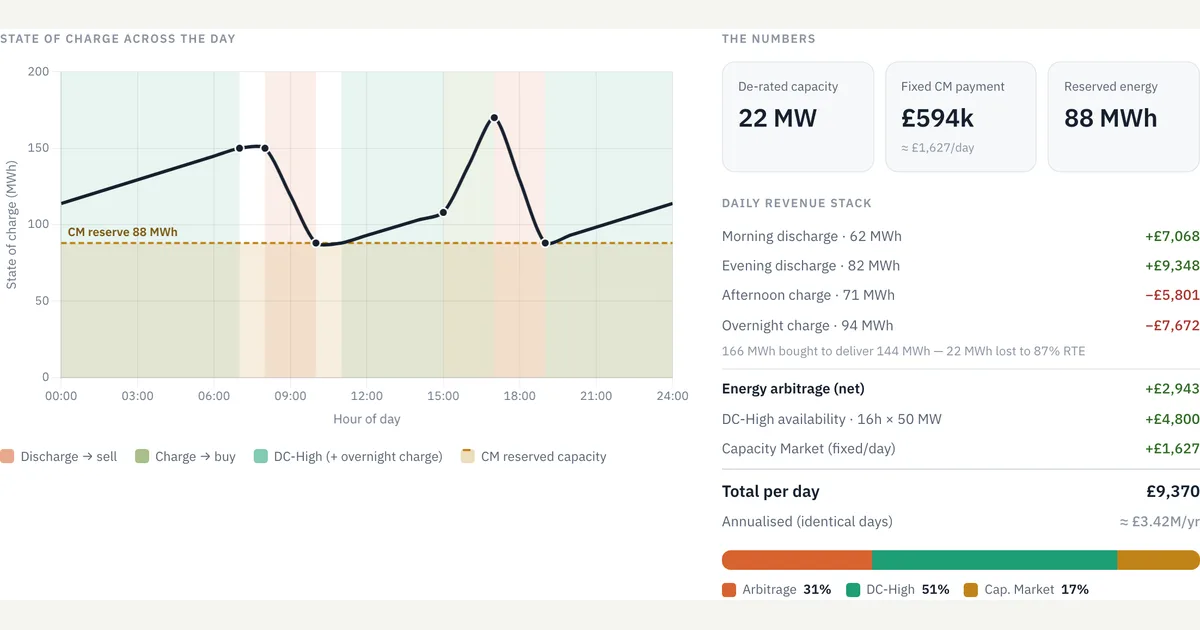 Interactive · bess.engineer ↗
 Numbers
Key facts
| Payment unit | $/kW-month, $/kW-year, or $/MW-day for accredited (not nameplate) capacity |
|---|---|
| Procurement timing | Forward auctions 1-4 years ahead (UK T-4 = 4 years; PJM BRA nominally 3) |
| Accreditation reference point | State MW net at POI after PCS/transformer/aux (~2-4% combined losses) and within the interconnection export limit — never DC nameplate |
| PJM clearing prices | Roughly $30-50/MW-day historically; ~$270/MW-day for 2025/26 (~$98/kW-yr) |
| UK Capacity Market | Recent T-4 clears ~£60-65/kW-year; up to 15-year agreements for new build |
| CAISO Resource Adequacy | Bilateral, not auctioned; system RA recently ~$7-15/kW-month in tight periods |
| ERCOT | No capacity market — energy-only design; batteries rely on energy + ancillary revenue |
| Storage accreditation | ELCC/derating: ~80-95% of nameplate at low penetration, falling toward 50-60% as storage saturates the peak |
| Duration threshold | Historically 4 h continuous discharge; slice-of-day and longer-duration rules emerging |
| Non-performance exposure | Steep per-MWh charges; annual stop-loss commonly ~1.5x annual capacity revenue (PJM CP) |
| Degradation planning | ~1.5-3%/yr early LFP fade → DC overbuild or augmentation to hold accredited MWh 10-15 yr |
| Life-safety standards | NFPA 855 installation, UL 9540 certification, UL 9540A test data, NFPA 68/69 deflagration protection |
Typical values and standards
Prices vary enormously by market and year, which is why single-point assumptions are dangerous. PJM Base Residual Auctions historically cleared around $30-50/MW-day, then the 2025/26 auction cleared near $270/MW-day RTO-wide (about $98/kW-year) and the next settled against a price cap near $329/MW-day — a step change driven by load growth and generator retirements.
Recent UK T-4 auctions have cleared on the order of £60-65/kW-year. CAISO system RA, transacted bilaterally, has recently run roughly $7-15/kW-month in tight periods. Build a price curve with sensitivity bands, never one number, because the difference swings project IRR by whole percentage points.
Capacity accreditation for storage is duration-based and derated — the number that actually sets revenue. Most markets credit a battery via effective load carrying capability (ELCC) or a derating factor: a 4-hour system might be accredited at roughly 80-95% of nameplate at low storage penetration, declining toward 50-60% as more storage saturates that narrow peak window.
The UK publishes explicit derating factors, roughly 10-15% for 1-hour assets rising above 90% for long durations. The classic threshold is 4 hours continuous discharge; CAISO's slice-of-day framework now evaluates contribution hour by hour, and required durations are trending longer.
Degradation sets the maintenance burden on the commitment: LFP systems typically lose 1.5-3% of capacity per year early in life, so a 100 MW / 400 MWh (4-hour, 0.25C) project must plan augmentation or initial DC overbuild to keep 400 MWh deliverable across a 10-15 year obligation.
LFP dominates stationary storage for cycle life and thermal-runaway margin; NMC appears mainly where energy density binds. The installation must also satisfy NFPA 855 for siting and spacing, with fire behavior characterized per the UL 9540A test method, whole-system safety certified to UL 9540, and deflagration protection per NFPA 68/69.
Sources & standards
In practice
Why it matters in a real grid-scale project
Capacity revenue is stable and forward-looking, which makes it central to project finance. Lenders favor a multi-year capacity contract or cleared auction position because predictable cash flow lowers the cost of capital versus a purely merchant project on volatile arbitrage spreads — the core tension in any merchant vs. contracted structure.
In the US the investment tax credit cuts installed capex so even a modest but firm capacity payment can clear a lender's coverage test. Most projects are financed around a capacity-plus-arbitrage revenue stacking strategy, with frequency regulation and other ancillary products layered on where rules allow.
The engineering consequence: the system must hold its accredited capacity across the whole contract term. That drives oversizing of DC blocks to offset cell degradation, augmentation planning (adding racks or containers to maintain rated MWh), thermal management to sustain the required C-rate at high ambient temperatures, and disciplined state-of-charge management so the committed energy is available during a call.
A POI export limit or PCS derating curve that caps deliverable power erodes the capacity the project is paid for, so the as-accredited number must reconcile with real net AC-side capability at the point of interconnection — not a DC nameplate.
How it shows up in specs, studies and contracts
An engineer meets the obligation first in the accreditation filing: the MW, duration, and seasonal availability the project registers with the ISO / RTO. Check that this number is stated net at the POI — after PCS, transformer, and auxiliary losses (commonly 2-4% combined) — not as DC nameplate or gross AC rating. The interconnection study and its export limit are the hard ceiling; if the study caps injection at 95 MW, accrediting 100 MW is a standing non-performance exposure. Ask explicitly which reference point every MW figure in the term sheet uses.
Contracts encode the risk, and warranty clauses must match it. PJM Capacity Performance charges non-performance at a steep per-MWh rate during emergency events, with an annual stop-loss commonly near 1.5 times the year's capacity revenue — one bad summer can wipe out more than a whole year's payment. ISO-NE runs a similar pay-for-performance scheme.
So capacity-maintenance guarantees from the supplier, an augmentation schedule sized to the fade curve, and O&M availability guarantees must all reference the same accredited MW and MWh at one measurement point. Mismatched reference points between filing and warranty are where projects silently under-deliver.
Operationally, the obligation shows up in dispatch software and test records: mandatory availability or capability demonstrations (periodic full-discharge tests in several markets), state-of-charge floors held ahead of forecast peak windows, and must-offer rules that constrain how much of the asset stays free for energy arbitrage or ancillary services on a given day. Review the market's storage participation rules for charging obligations too — some require the battery charged and ready by a defined hour, which the EMS must enforce automatically.
Pitfalls
Common pitfalls
The most common modeling error is mixing reference points: quoting accredited capacity from DC nameplate, ignoring the roughly 2-4% chain of PCS, transformer, and auxiliary losses to the POI, or assuming beginning-of-life MWh persists through year 15 (BOL is not EOL). A related trap is treating ELCC as fixed for the contract term — most frameworks re-evaluate it periodically, and storage-class ELCC has drifted down as penetration rises, so a model built on year-one accreditation overstates the out-years and the revenue that finances the deal.
Finally, do not double-commit the asset. Capacity obligations, ancillary-service awards, and arbitrage schedules all draw on the same MW and the same state of charge; market rules differ on what may stack simultaneously, and a battery that sold its flexibility into frequency regulation may be unable to hold the SOC its capacity obligation implies when the call comes.
Residential and EV fleets aggregated as virtual power plants face the same accreditation logic, but at utility scale the penalties are large enough that the EMS, not a trader's spreadsheet, must be the final enforcer of the committed position.
Common misconception
A 100 MW battery earns capacity payments on its full 100 MW nameplate rating.
In reality: Storage is accredited on a derated, duration-aware basis — an ELCC or explicit derating factor, then further adjusted for degradation and POI losses. A 100 MW / 400 MWh system is typically credited for materially less than 100 MW, often 50-95% depending on market and penetration. That accredited number, not nameplate, sets both the revenue and the firm performance obligation whose non-performance penalties can exceed a full year's payment.
Go further
Visuals & further reading
- How Grid Batteries Make Money: BESS Revenue Streams Article
- Interactive: Revenue Stacking Example Interactive visual · bess.engineer
- Interactive: The Duck Curve Interactive visual · bess.engineer
Capacity market, in context.
How a Battery Gets Paid covers capacity market — and the rest of the revenue stack — from the ground up, the way it actually gets deployed.